Result: Summary judgment granted in full in favor of SNAILS. Damages: $1.5 million CAD. Permanent injunction issued.
Court findings: Justice Devlin found that Higgins acted with malice and reckless disregard for the truth. The judgment found that she repeatedly ignored contradictory information and described her stated motive as a “career-destroying campaign against a total stranger.” It identified an “intentionally, demonstrably false attack,” found other allegations contradicted by messages and records created at the time, and found many allegations, including the most serious, likely false or at minimum unreliable.
Jump to a question27 questions
SNAILS Lawsuit Explained — Part 1
1
What was the SNAILS lawsuit about?
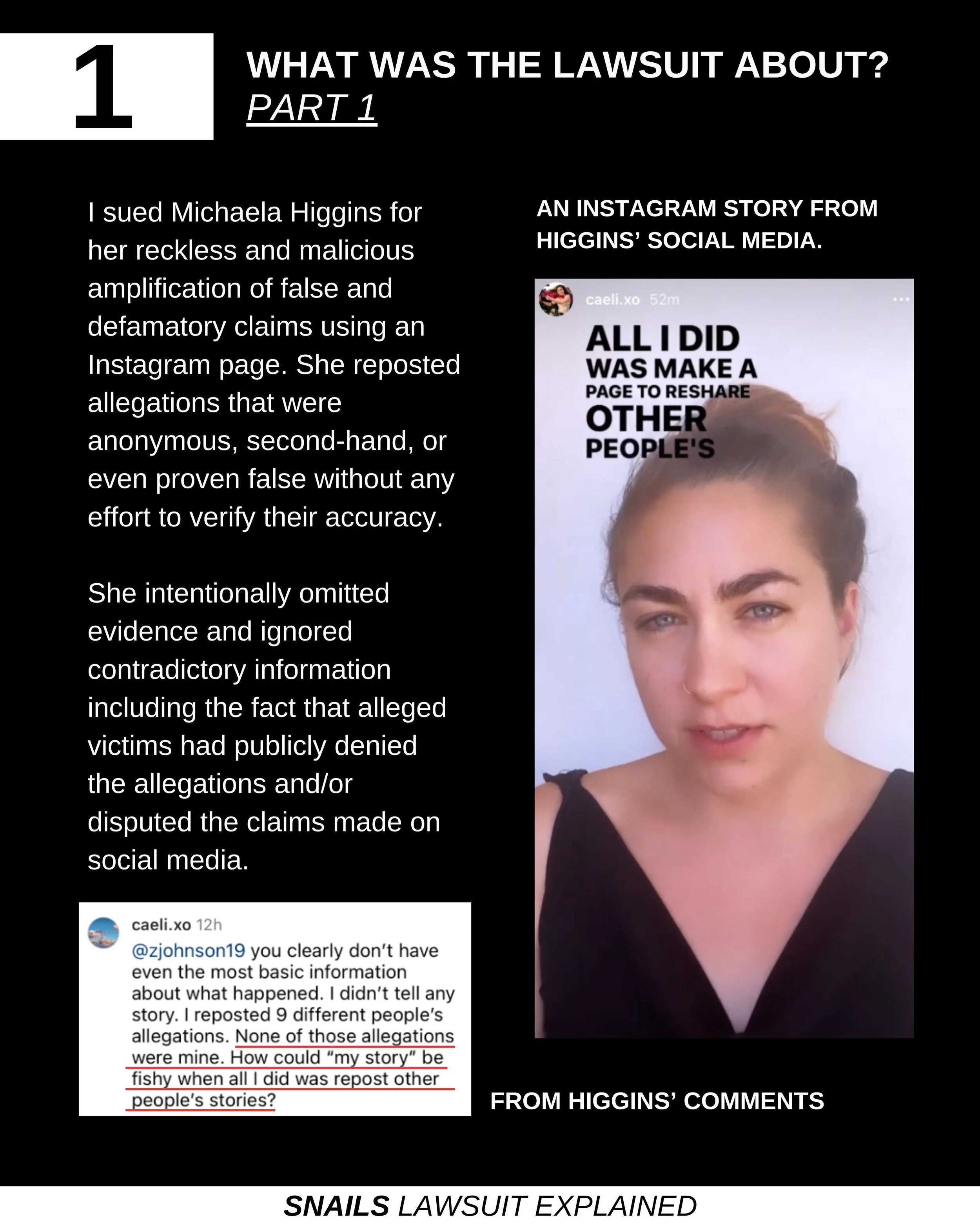
I sued Michaela Higgins for her reckless and malicious amplification of false and defamatory claims using an Instagram page. She reposted allegations that were anonymous, second-hand, or even proven false without any effort to verify their accuracy.
She intentionally omitted evidence and ignored contradictory information — including the fact that alleged victims had publicly denied the allegations and disputed the claims made on social media.
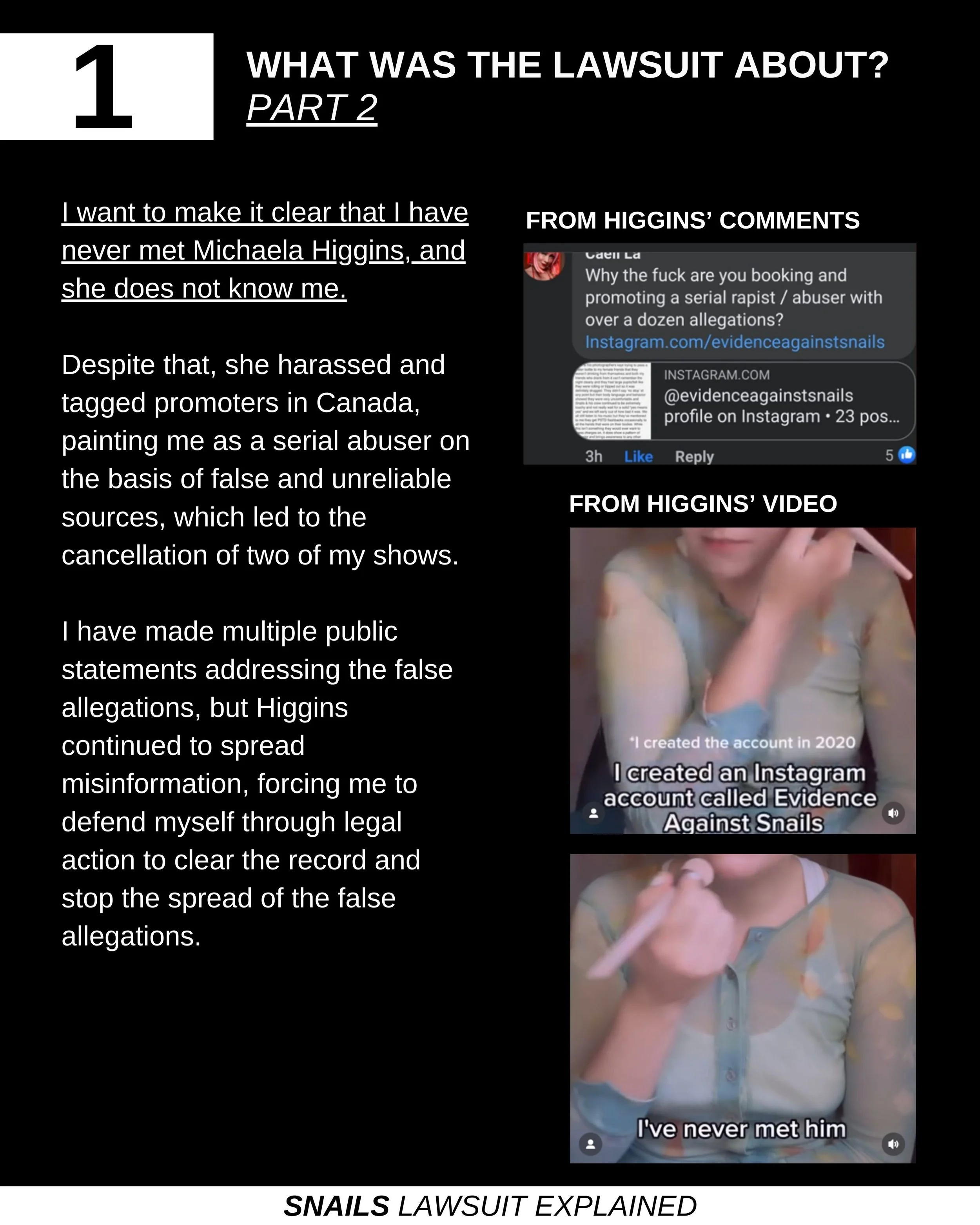
I want to make it clear that I have never met Michaela Higgins, and she does not know me. Despite that, she harassed and tagged promoters in Canada, painting me as a serial abuser on the basis of false and unreliable sources — which led to the cancellation of two of my shows in Alberta.
Court of King's Bench — Justice Devlin [para 1]
The Instagram Account was operated by Michaela Higgins, who lives in California. She has never met Mr. Durand and does not appear to have any first-hand knowledge of any of the allegations she republished.
Justice Devlin [para 11]
All the material posted on the Instagram Account was second or third-hand, consisting of reposts. All the material was aimed at branding Mr. Durand a criminal and sexual predator. An obvious collateral purpose of the Instagram Account was to "cancel" Mr. Durand, frequently tagging his agent, producers, and venues where he was to perform.
Wasn't this a default judgment because Higgins didn't show up?
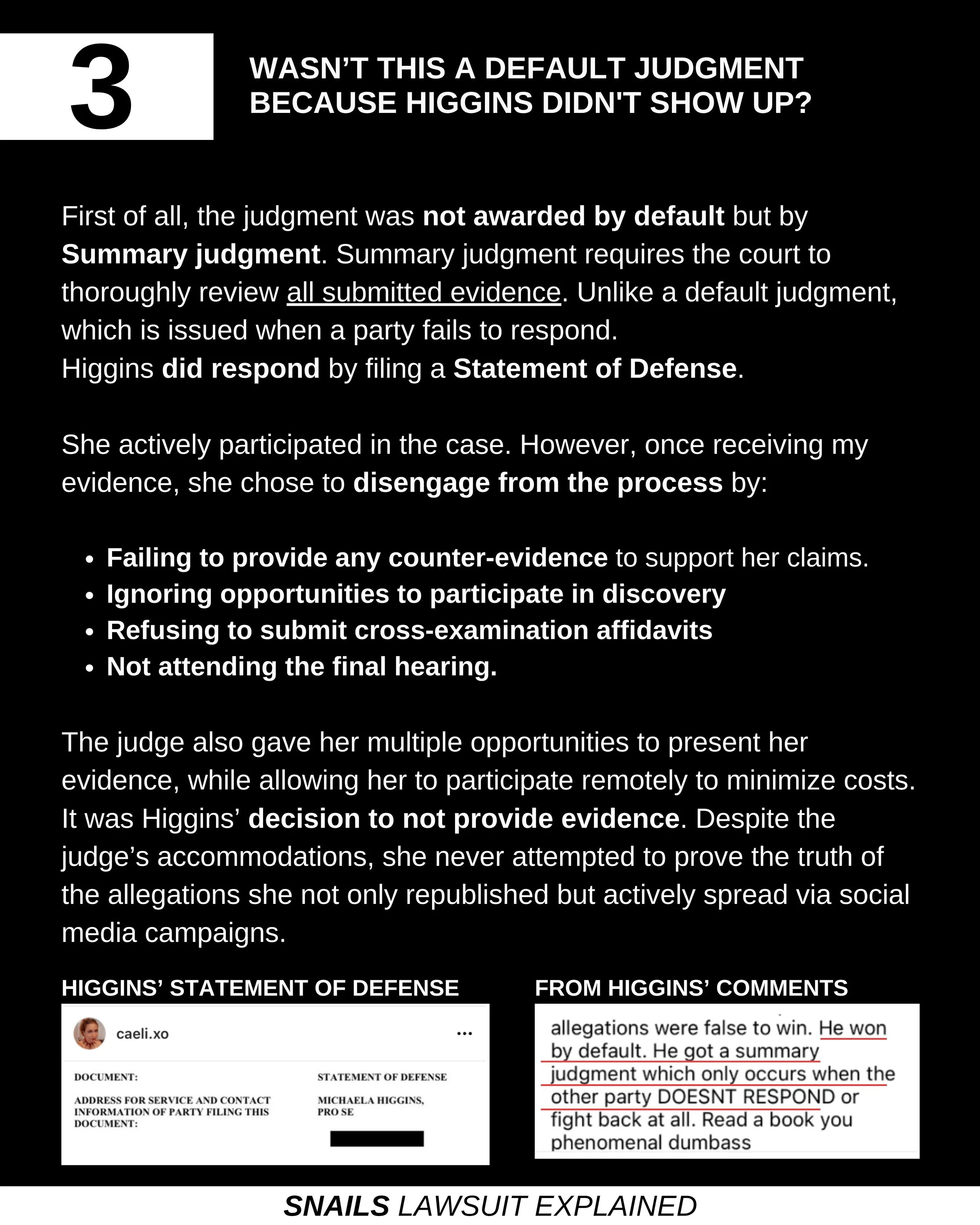
The judgment was not awarded by default but by Summary Judgment. Summary judgment requires the court to thoroughly review all submitted evidence — unlike a default judgment, which is issued when a party fails to respond entirely.
Higgins did respond by filing a Statement of Defense. She appeared at a case management hearing before Justice Harris in August 2023. She was given every opportunity, including virtual attendance, to participate.
However, once receiving my evidence, she chose to disengage completely:
Failing to provide any counter-evidence to support her claims
Ignoring opportunities to participate in discovery
Refusing to submit cross-examination affidavits
Not attending the December 8, 2023 final hearing despite Webex links being sent to her
Justice Devlin [para 6]
Mr. Durand complied with the timeline for providing his evidence and arguments in favour of summary judgment. Ms. Higgins filed nothing in response. Webex links were prepared and sent to Ms. Higgins for her to appear virtually, as she had before. Ms. Higgins, however, did not appear.
Justice Devlin [para 58]
The wilful failure of one party to participate in the summary judgment process is not, of itself, a reason to doubt the sufficiency of the record. Litigants make tactical choices at their own risk.
Wasn't the SNAILS case an unfair use of foreign courts — "libel tourism"?
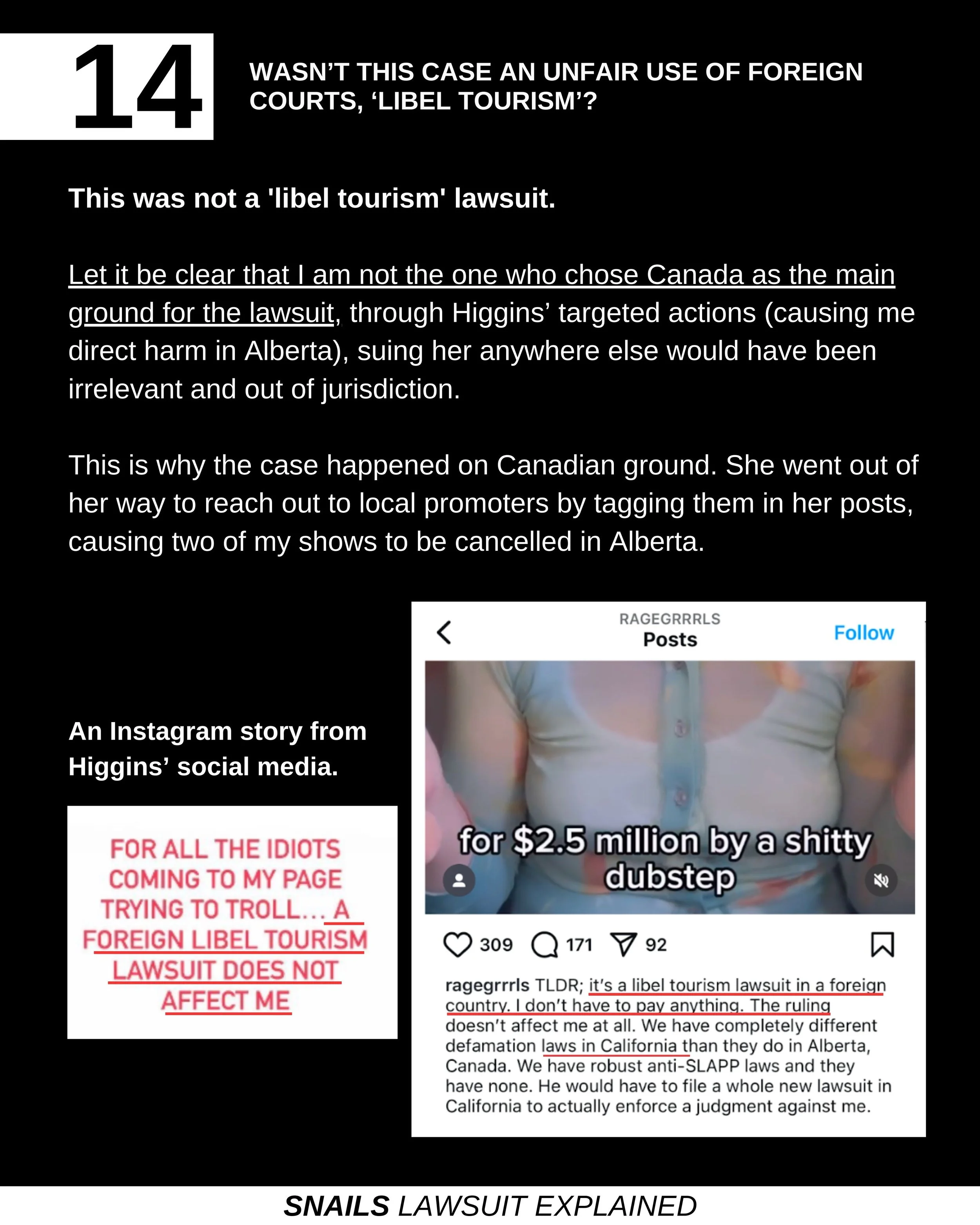
This was not a libel tourism lawsuit. Justice Devlin explicitly addressed and rejected this argument in the official judgment.
I did not choose Canada as the forum. Higgins chose Alberta through her own actions — she specifically and repeatedly tagged Edmonton and Calgary promoters in her posts, causing two of my scheduled performances to be cancelled. She created the jurisdiction herself.
Justice Devlin [para 29]
A dominant purpose of the Instagram Account was to "cancel" the Applicant's career. Ms. Higgins intended that her posts would make people think ill of Mr. Durand in the places he was set to perform. Indeed, she specifically tagged the Alberta entities she wished her posts to negatively influence.
Justice Devlin [para 31–32]
I find as a fact that Ms. Higgins intended for her publications to lower Mr. Durand's reputation in Alberta specifically. While Ms. Higgins expresses indignation and surprise at being sued here, one wonders how that can be so. She clearly meant for Mr. Durand's performances here to be impacted or cancelled. Being sued where she succeeded is hardly unfair or unforeseeable.
Justice Devlin [para 46] — On Anti-SLAPP / Libel Tourism
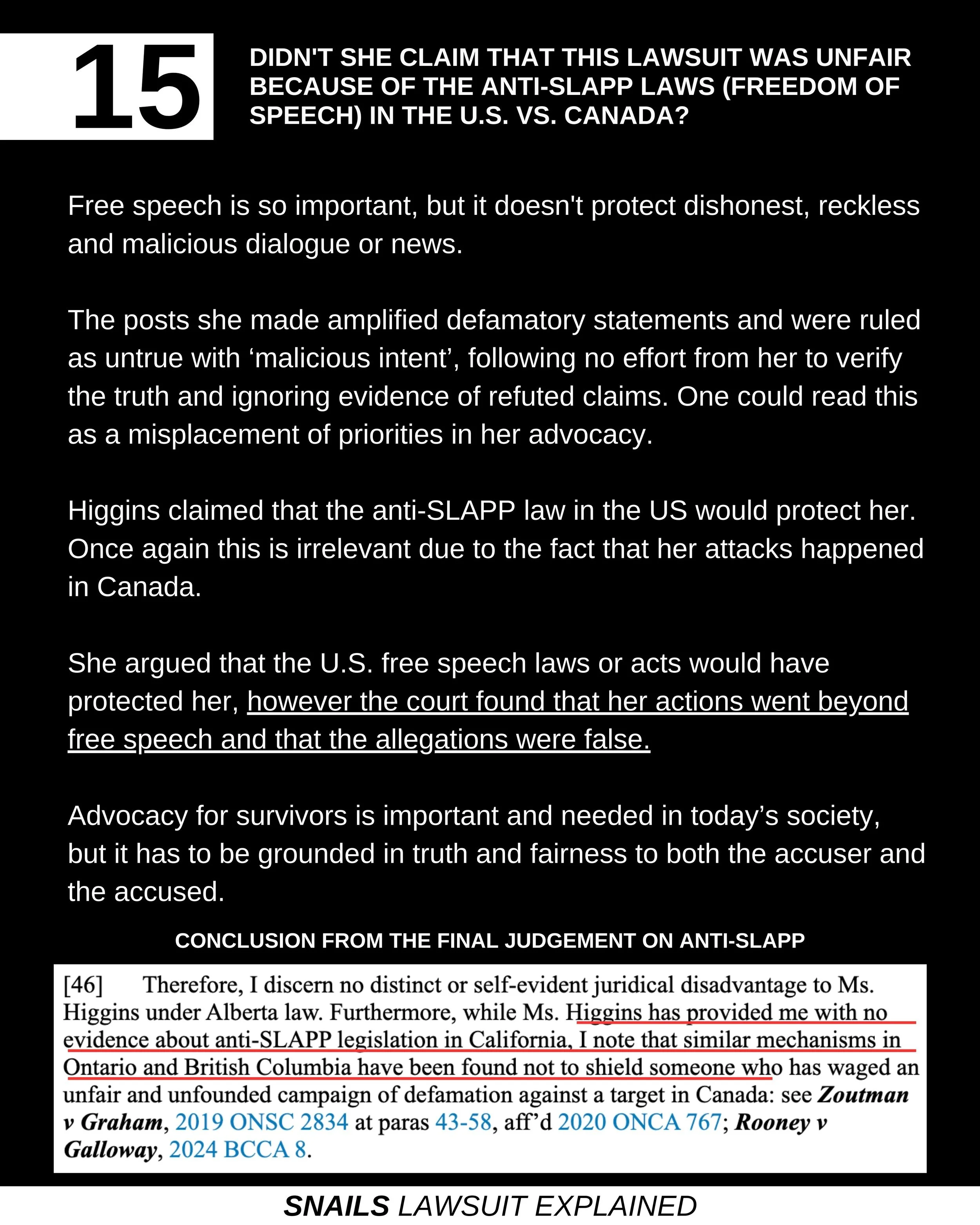
I discern no distinct or self-evident juridical disadvantage to Ms. Higgins under Alberta law. Furthermore, while Ms. Higgins has provided me with no evidence about anti-SLAPP legislation in California, I note that similar mechanisms in Ontario and British Columbia have been found not to shield someone who has waged an unfair and unfounded campaign of defamation against a target in Canada.
Official Court Finding
The presumption of jurisdiction was not rebutted. It is both permissible and appropriate for the Alberta Courts to take jurisdiction over this dispute. (Justice Devlin, para 33 and 51)
Why did SNAILS sue Higgins in Alberta instead of California where she lives?
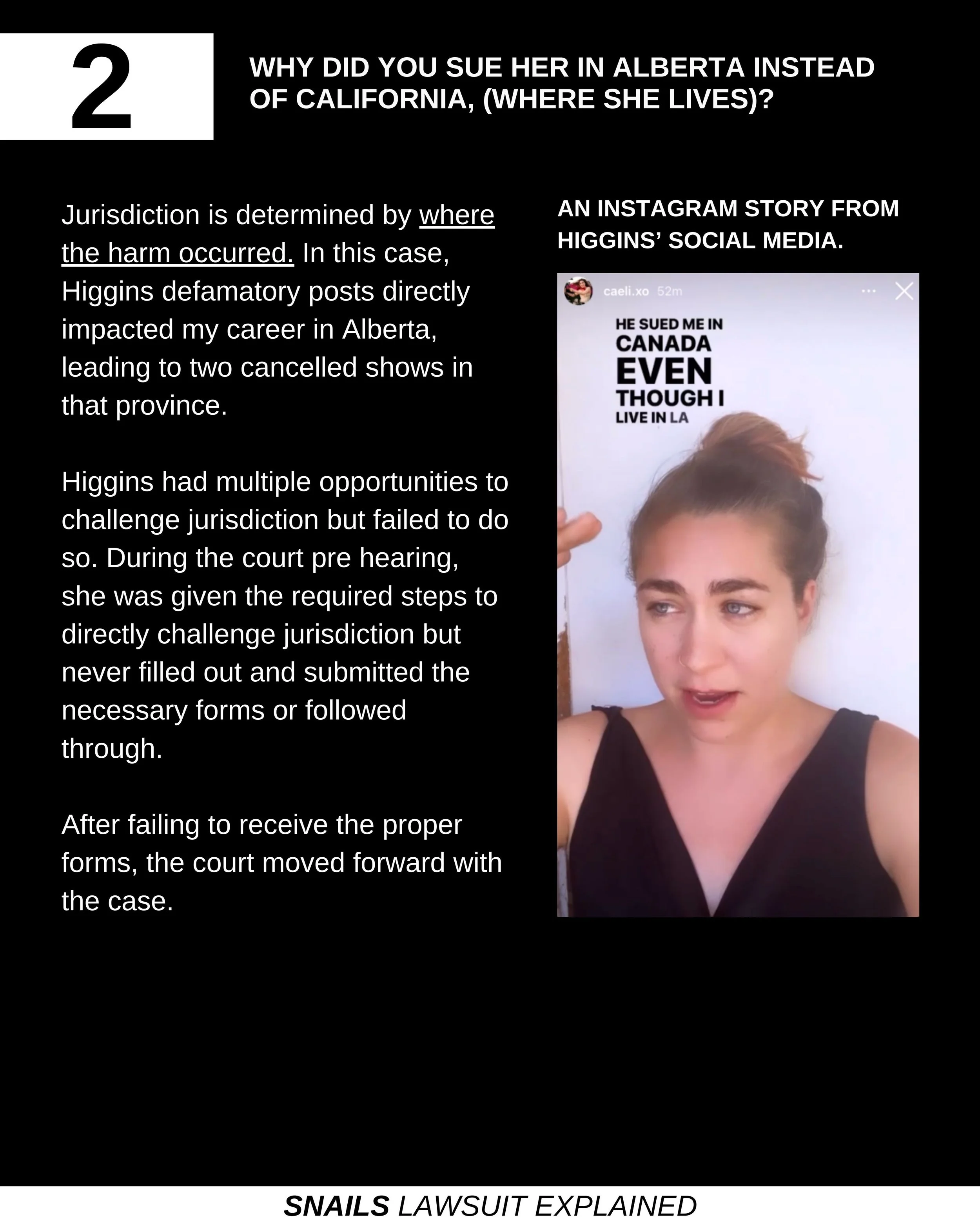
Jurisdiction is determined by where the harm occurred. The defamatory posts from the Instagram Account were directly read and acted upon by concert promoters in Alberta, who then cancelled my shows. The tort of defamation was committed in Alberta — where it was read and where its effects were felt.
Higgins had multiple opportunities to formally challenge jurisdiction but chose not to. Justice Harris set a deadline for her to file a motion challenging jurisdiction — she never did.
Justice Devlin [para 24]
Mr. Durand has provided evidence that the defamatory statements from the Instagram Account tagged, and were conveyed to, the concert promoters in Alberta who cancelled his events. Therefore, Mr. Durand has established on a balance of probabilities that the tort of defamation was committed against him in Alberta.
Justice Devlin [para 5]
Justice Harris imposed a litigation plan for the case to move forward. She set a schedule for the summary judgment process and a deadline for Ms. Higgins to file a motion challenging this Court's jurisdiction. Ms. Higgins chose not to file such an application.
Didn't Higgins lose because she couldn't afford legal representation in Canada?
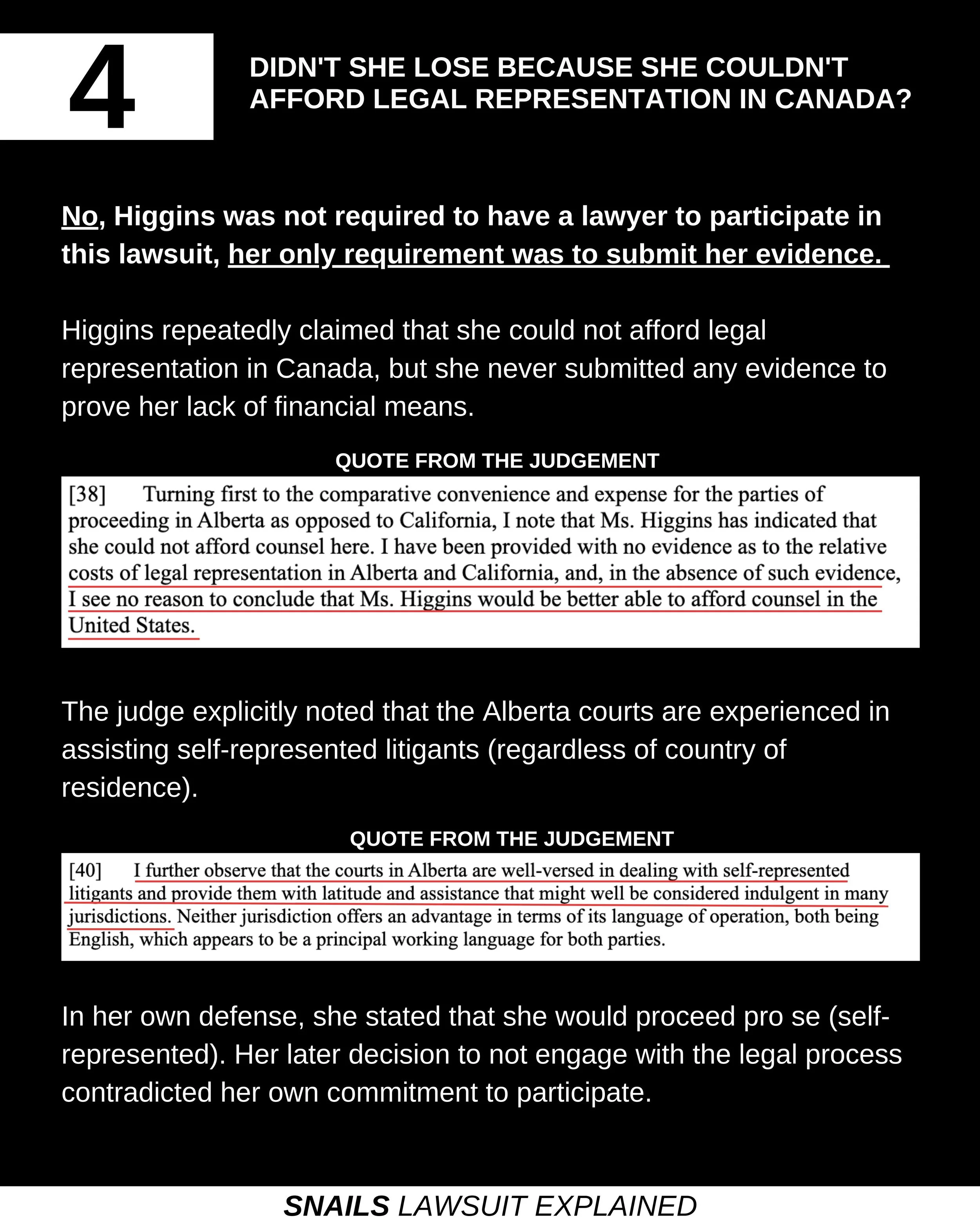
No. Higgins was not required to have a lawyer. Her only requirement was to submit her evidence. She repeatedly claimed she could not afford Canadian legal representation but never submitted any evidence to prove her lack of financial means. The court explicitly addressed and rejected this argument.
Justice Devlin [para 38]
Turning first to the comparative convenience and expense for the parties of proceeding in Alberta as opposed to California, I note that Ms. Higgins has indicated that she could not afford counsel here. I have been provided with no evidence as to the relative costs of legal representation in Alberta and California, and, in the absence of such evidence, I see no reason to conclude that Ms. Higgins would be better able to afford counsel in the United States.
Justice Devlin [para 39–40]
With Ms. Higgins having decided to defend against this application pro se, our Court's flexible capacity to accommodate remote testimony and submissions would have allowed her to self-represent without incurring travel expenses. Ms. Higgins appeared virtually from California on the single instance she chose to participate, and I would have permitted her to do so again. The courts in Alberta are well-versed in dealing with self-represented litigants and provide them with latitude and assistance that might well be considered indulgent in many jurisdictions.
Higgins stated she would proceed self-represented (pro se). Her later decision to not engage contradicted her own commitment to participate.
The court ruled in my favor because the evidence overwhelmingly supported my case and Higgins provided zero counter-evidence. Justice Devlin found that Higgins repeatedly defamed me by reposting allegations that I was guilty of criminal and immoral activity, without legal justification or basis for doing so.
None of the available legal defences applied — no defence of truth, no fair comment, no qualified privilege, and no responsible communication. Malice defeated all remaining defences.
Justice Devlin [para 133]
Mr. Durand has established that Ms. Higgins repeatedly defamed him by reposting allegations that he was guilty of criminal and immoral activity of the most serious type, without legal justification or basis for doing so. He has established that many of the allegations against him, including the most serious ones, are likely false, or at a minimum unreliable.
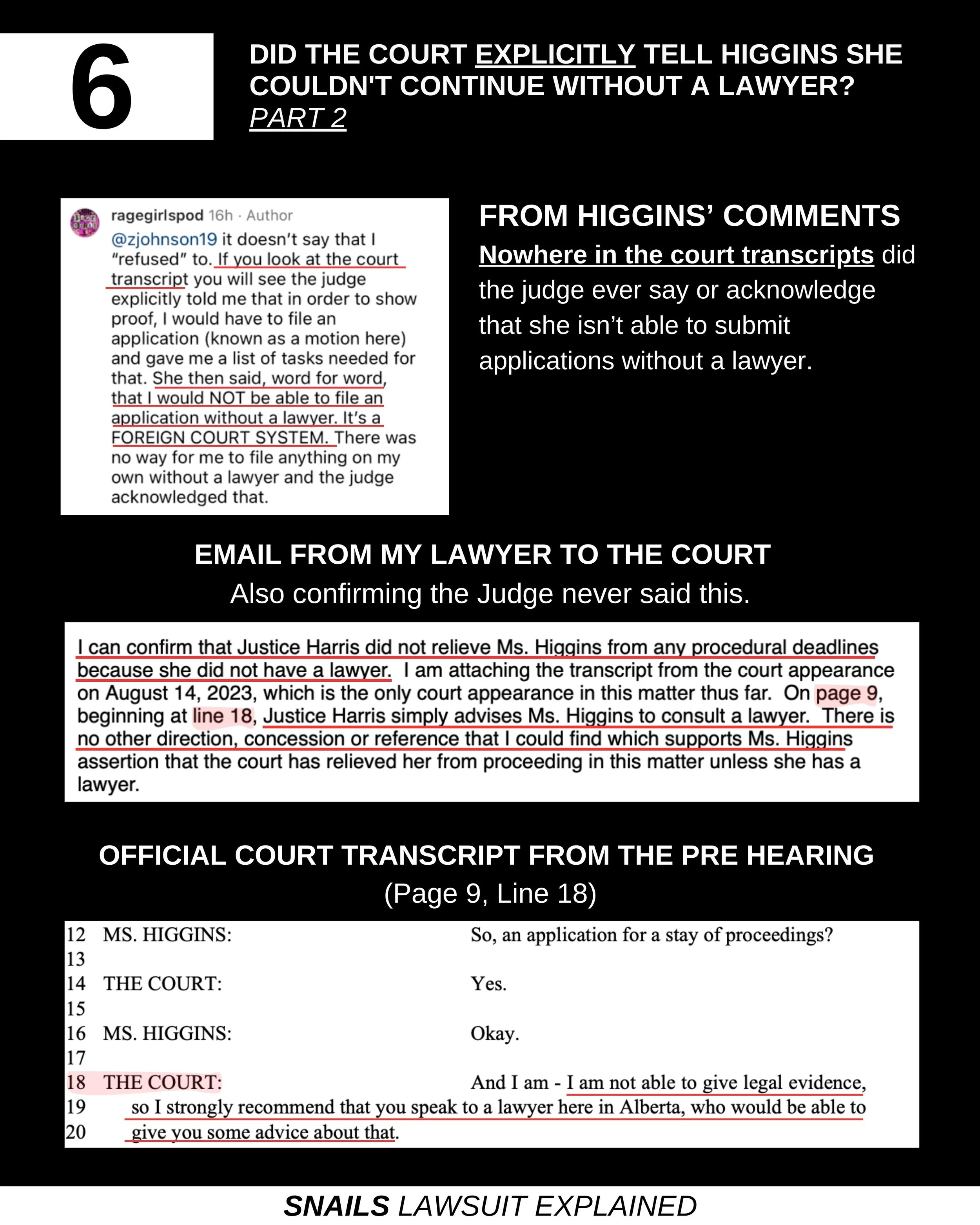
Did the court explicitly tell Higgins she couldn't continue without a lawyer?
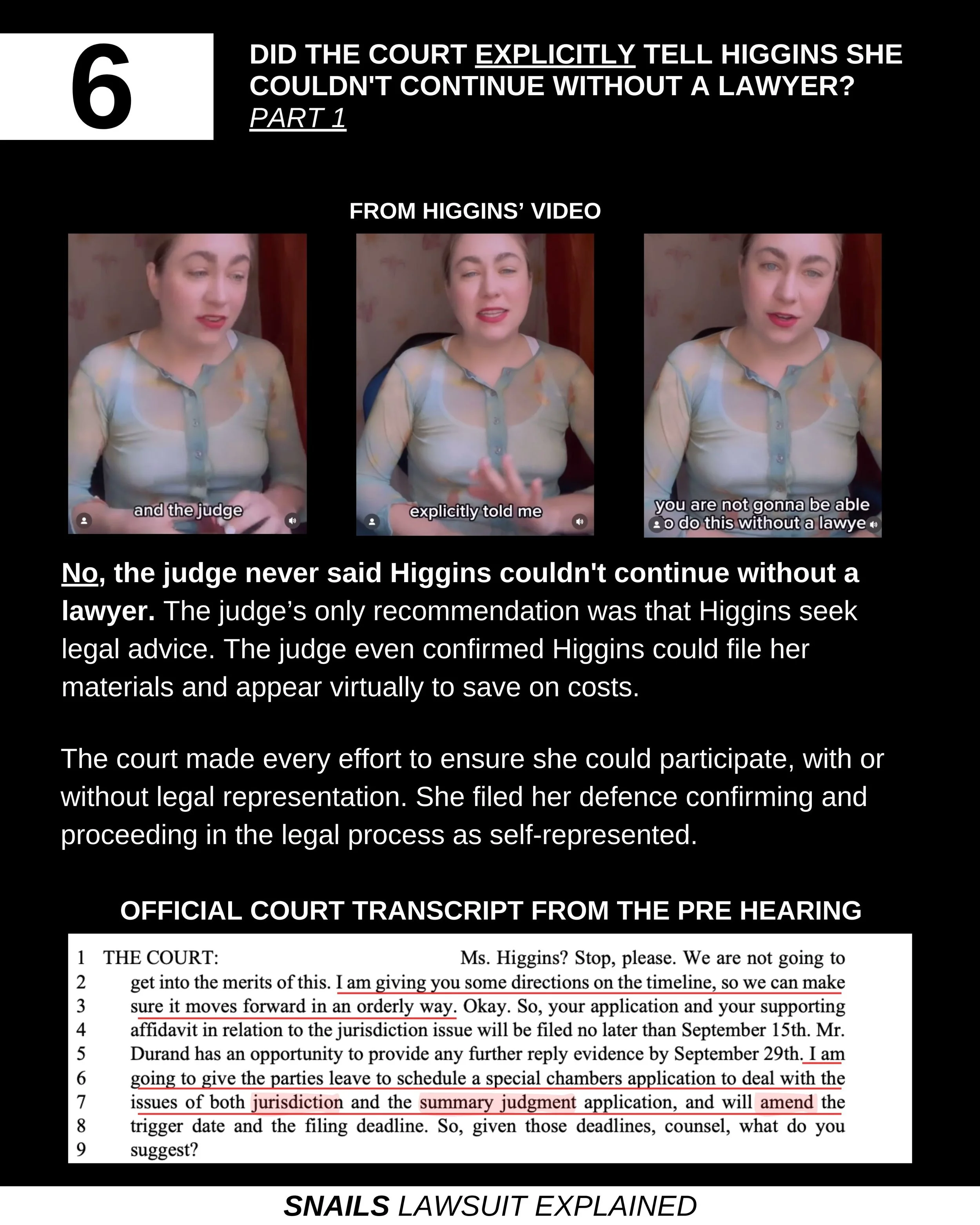
No. The court transcript shows Justice Harris recommended Higgins seek legal advice — nothing more. The court never told her she could not proceed without a lawyer. The court explicitly made accommodations for her to appear remotely and participate without counsel.
Official Court Transcript — Pre-Hearing, Page 9 Line 18
THE COURT: And I am — I am not able to give legal evidence, so I strongly recommend that you speak to a lawyer here in Alberta, who would be able to give you some advice about that.
This is a recommendation, not a prohibition. My lawyer confirmed in writing to the court that Justice Harris did not relieve Higgins from any procedural deadlines because she did not have a lawyer, and that there was no basis for her claim that the court excused her from participating without legal representation.
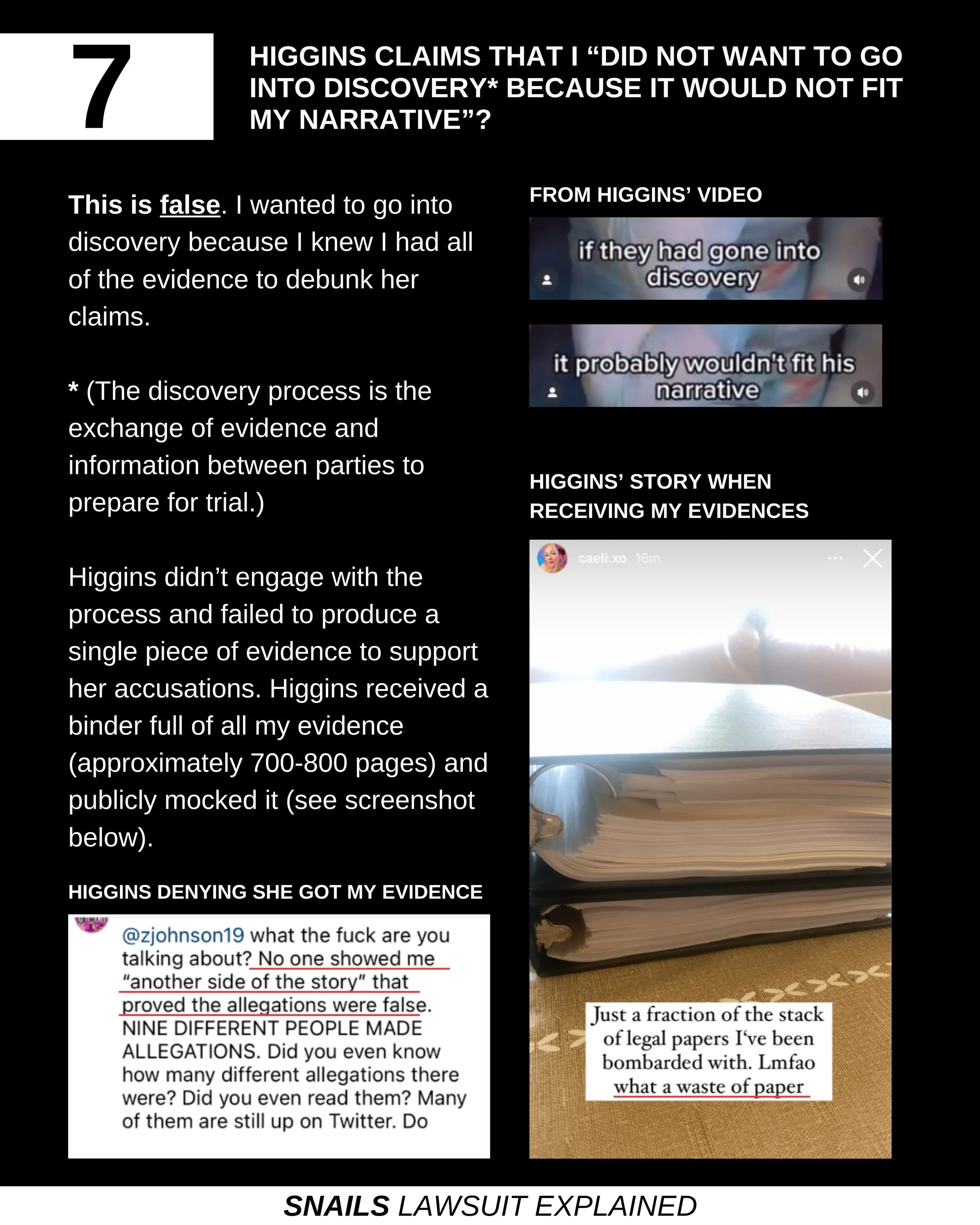
Higgins claimed SNAILS didn't want to go into discovery because it wouldn't fit his narrative
This is false. I wanted to go into discovery because I had all the evidence needed to debunk her claims. The court record shows I submitted approximately 700–800 pages of evidence across ten detailed affidavits.
Higgins received the full evidence binder and publicly mocked it on social media — calling it "a waste of paper." She then submitted zero pages of her own evidence and refused to cross-examine any of my affidavits.
Justice Devlin [para 57]
The extensive record before me largely mirrors what would be heard and presented at a trial. Ms. Higgins had a right to cross-examine on the affidavits before me and has not done so. She similarly had a right to file her own affidavit material and has not done so.
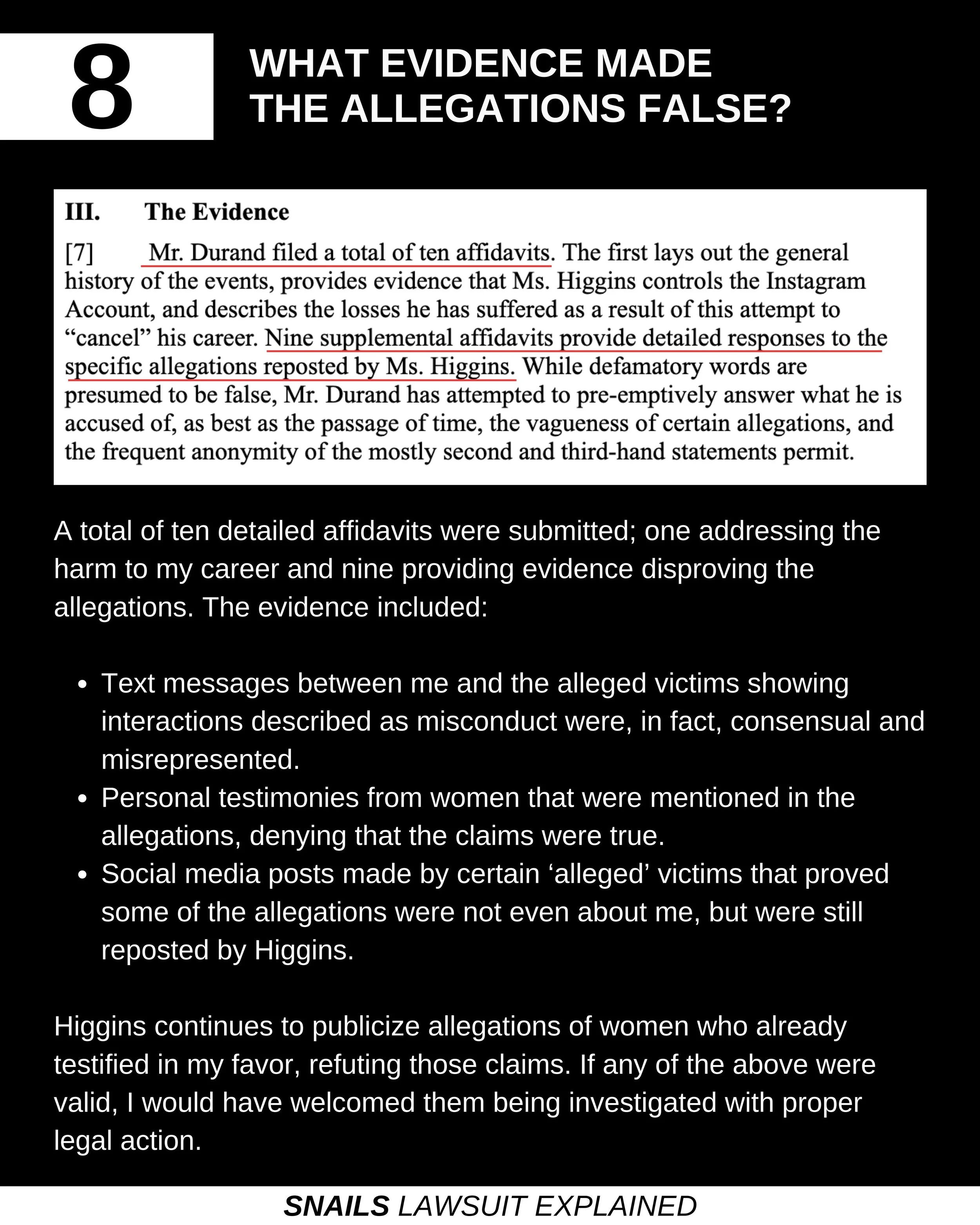
I filed ten affidavits addressing each allegation specifically. The court examined several in detail and found them false on the civil standard of proof. Here is what the judgment found on specific allegations:
Krysten (Philadelphia allegation): The alleged victim Krysten publicly refuted the allegation, stating it was false, offering to back Durand up, and confirming the encounter was consensual. Higgins posted the allegation anyway while omitting Krysten's public retraction from the same thread.
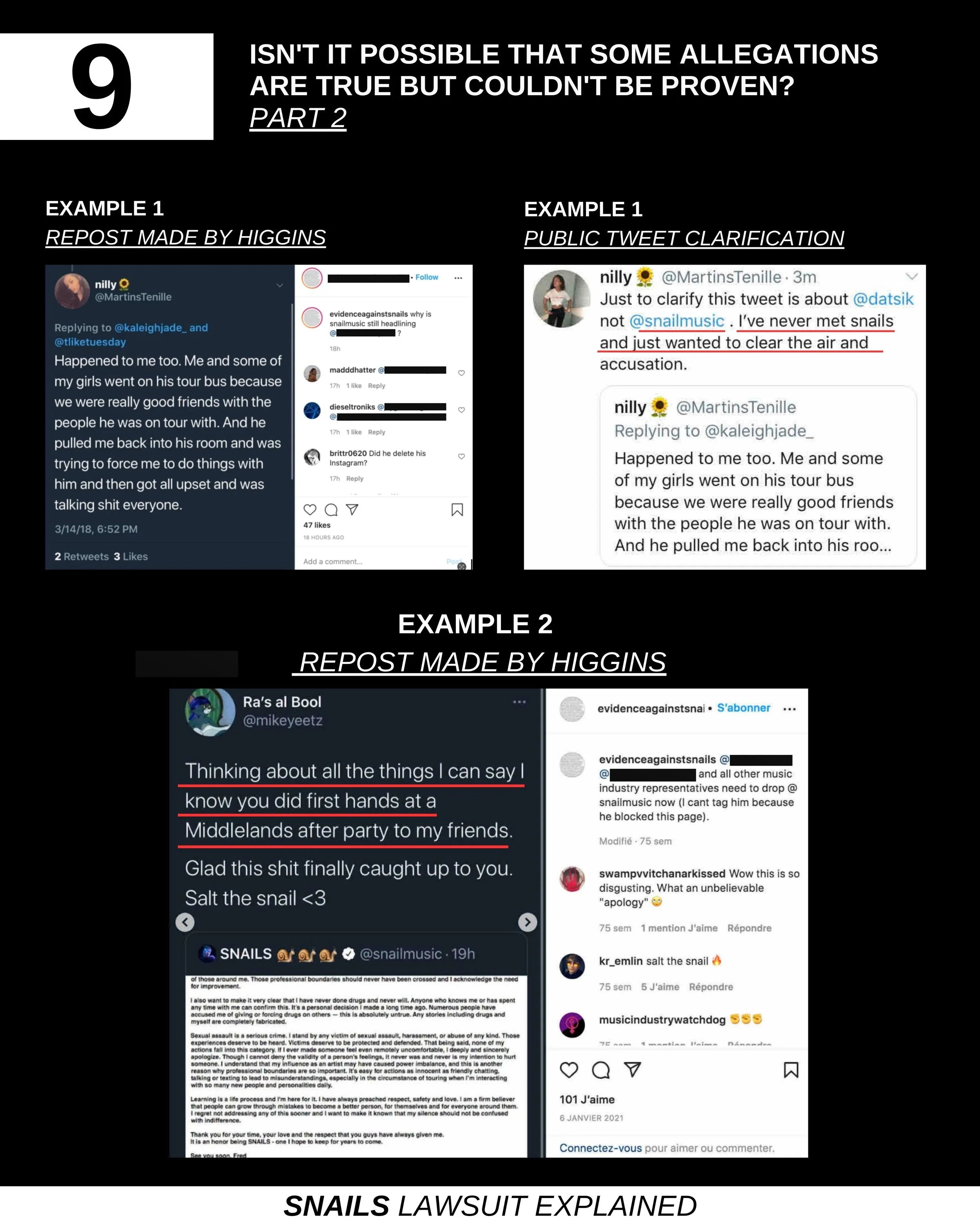
@MartinsTenille: The original poster publicly clarified her tweet was about a different DJ entirely — not Snails — tweeting "I've never met snails." Higgins posted the allegation anyway and omitted the clarification.
Caroline: The person who alleged assault had sent Durand sexually explicit messages and pursued him consensually through 2017. The court found the private messages wholly inconsistent with the allegation.
Shelby: Dated text messages from Shelby thanked Durand for "the fun" and invited future meetups. Her own public tweet at the time praised the interaction.
Kasey Connelly's false social media allegations debunked by her own posts and messages
Kasey Connelly (@kaseycon / @harlequinof8): Her public story changed repeatedly and directly contradicted itself. In public posts, she wrote, "Fred assaulted me." She also wrote, "I wasn't raped," and said Durand "wasn't aggressive."
She also claimed Durand took her phone and that they communicated only through Snapchat. The dated iMessages reproduced in Durand's 2022 public statement contradict both claims. They show her using her phone to arrange the meeting, messaging him throughout the night, and writing afterward, "Thank you so much for having me last night."
Mr. Durand filed nine supplementary affidavits outlining and addressing specific defamatory posts. He has managed to do so to a surprising extent, given the nature of the allegations and the passage of time. These detailed affidavits also provide the evidence he relies upon to demonstrate that Ms. Higgins acted with a reckless disregard for the truth of what she reposted.
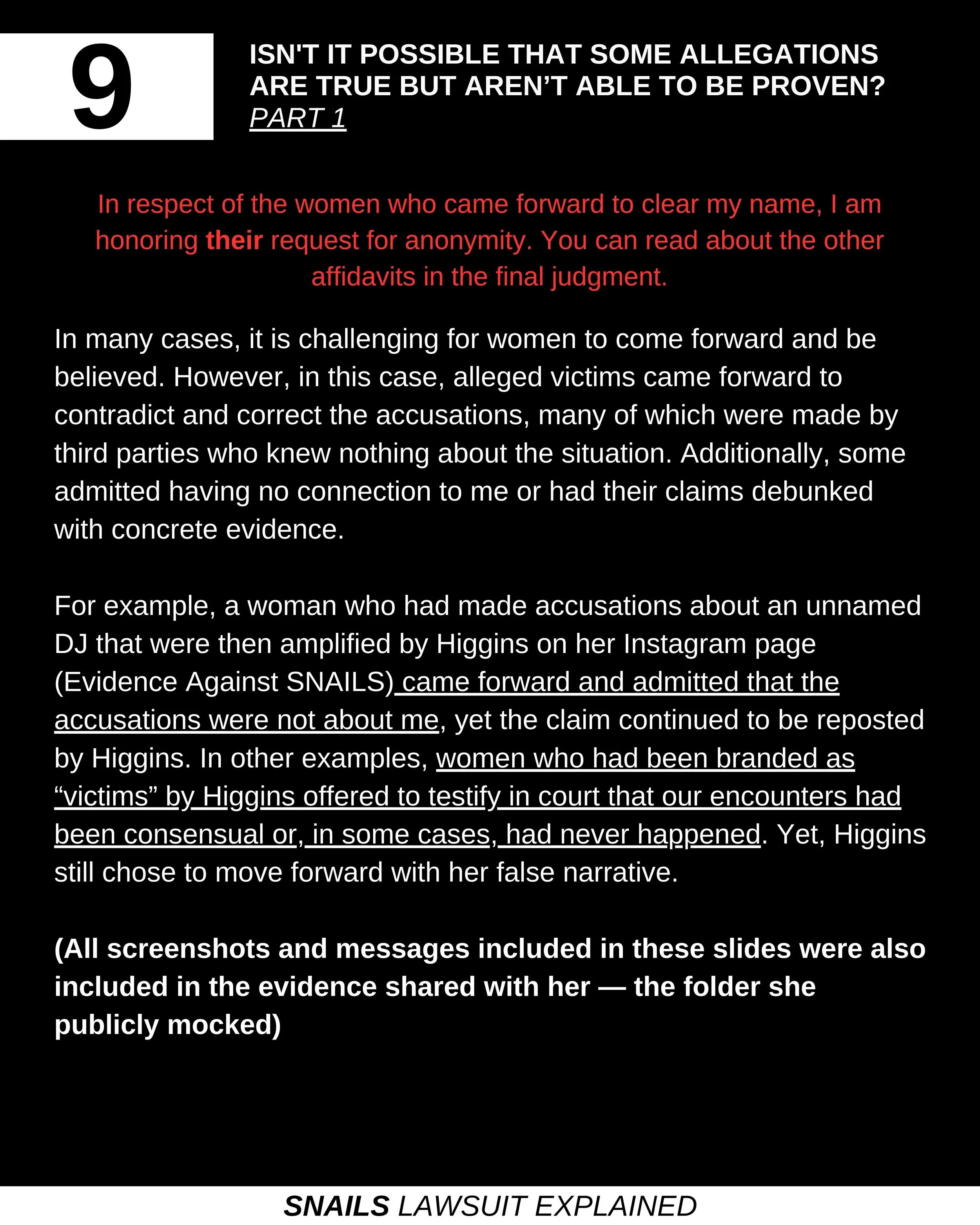
Isn't it possible some SNAILS allegations are true but can't be proven?
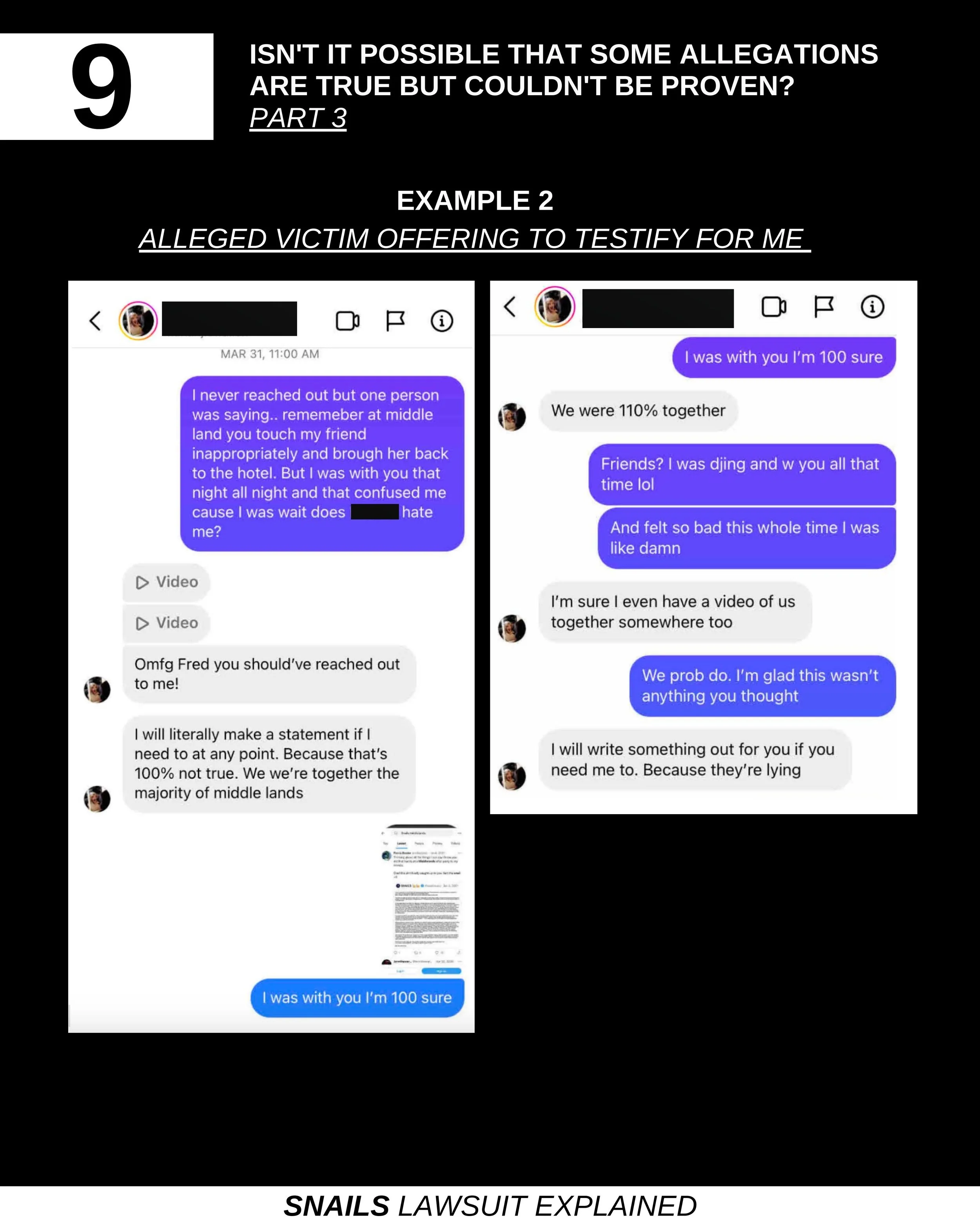
In many cases, it is challenging for women to come forward and be believed. However, in this case, alleged victims came forward to contradict and correct the accusations. Women identified in the allegations offered to testify for me in court. Some of those Higgins branded as "victims" confirmed the encounters were consensual or had never happened at all.
A specific example from the official judgment: a woman whose tweet was reposted by Higgins as an allegation against SNAILS publicly clarified it was about a different DJ entirely. Higgins kept the post up and omitted the clarification. Justice Devlin called this the "epitome of malicious conduct."
Justice Devlin [para 88–89]
Notwithstanding the fact that the original allegation was almost immediately qualified as having nothing to do with Mr. Durand, the Instagram Account posted it as evidence of his alleged sexual misconduct. Posting the retracted @MartinsTenille allegation was not only defamatory but an intentionally, demonstrably false attack on Mr. Durand's reputation. It is the epitome of malicious conduct, calculated to destroy the target's reputation, carried out with flagrant and intentional disregard of the falsity of what was being said.
Did anyone come forward to testify or confirm Higgins' claims?
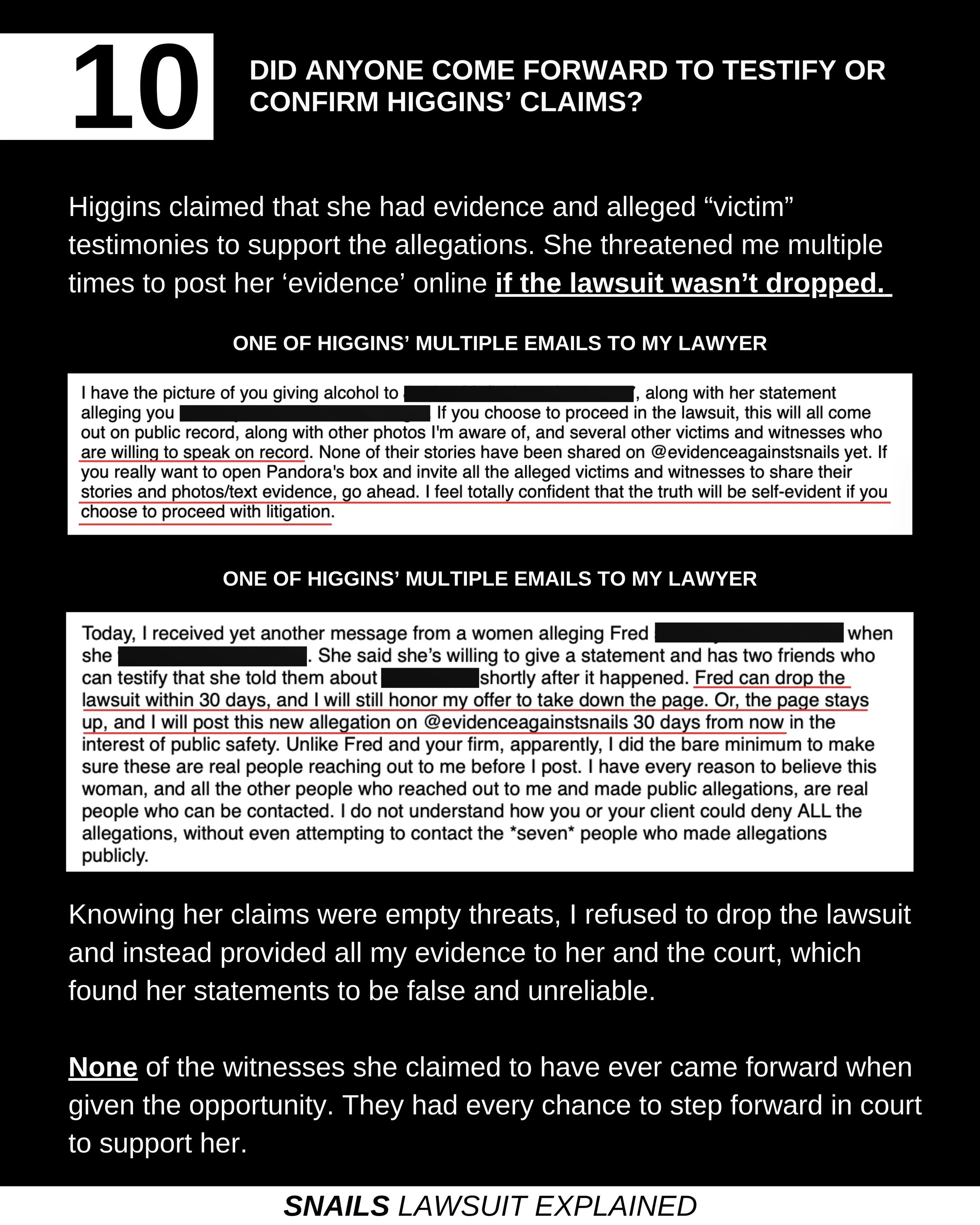
Higgins claimed repeatedly to have evidence and witnesses. She threatened to post additional allegations and produce witnesses if the lawsuit continued. When the time came — she produced nothing.
Not one person came forward to provide credible evidence supporting any allegation against me in court. The court noted that Higgins had the right to cross-examine my affidavits and the right to file her own evidence — and exercised neither right.
Official Court Finding
Zero witnesses. Zero counter-evidence submitted. Higgins absented herself entirely from the December 8, 2023 hearing. The court proceeded on the uncontradicted record.
Why didn't SNAILS sue the accusers directly instead of Higgins?
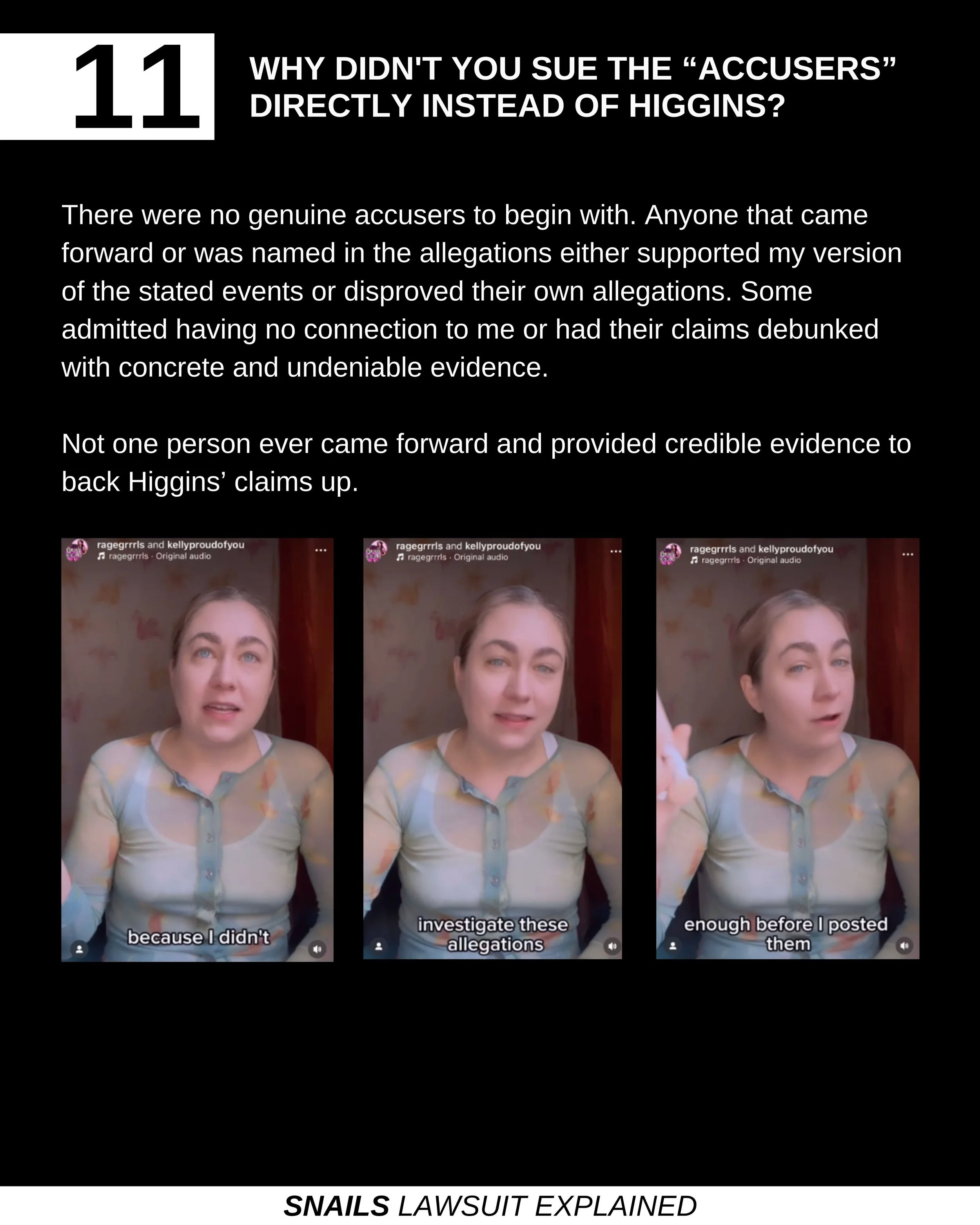
There were no genuine accusers to begin with. Anyone that came forward or was named in the allegations either supported my version of events, disproved their own allegations, admitted having no connection to me, or could not be identified at all due to anonymity.
The court's repetition rule is clear on this point: every person who reposts a defamatory statement is liable to the same extent as the person who originally published it. Higgins amplified, organized, and broadcast these allegations to the public — that is actionable regardless of who originally posted them.
Justice Devlin [para 70–71]
A repetition, republication, or repost of a defamatory statement is every bit as defamatory, and every bit as subject to liability in tort, as the original statement. The Supreme Court has observed that maintaining the repetition rule is particularly important in the age of the Internet, when defamatory material can spread from one website to another at great speed.
Why didn't SNAILS settle the case with Higgins outside of court?
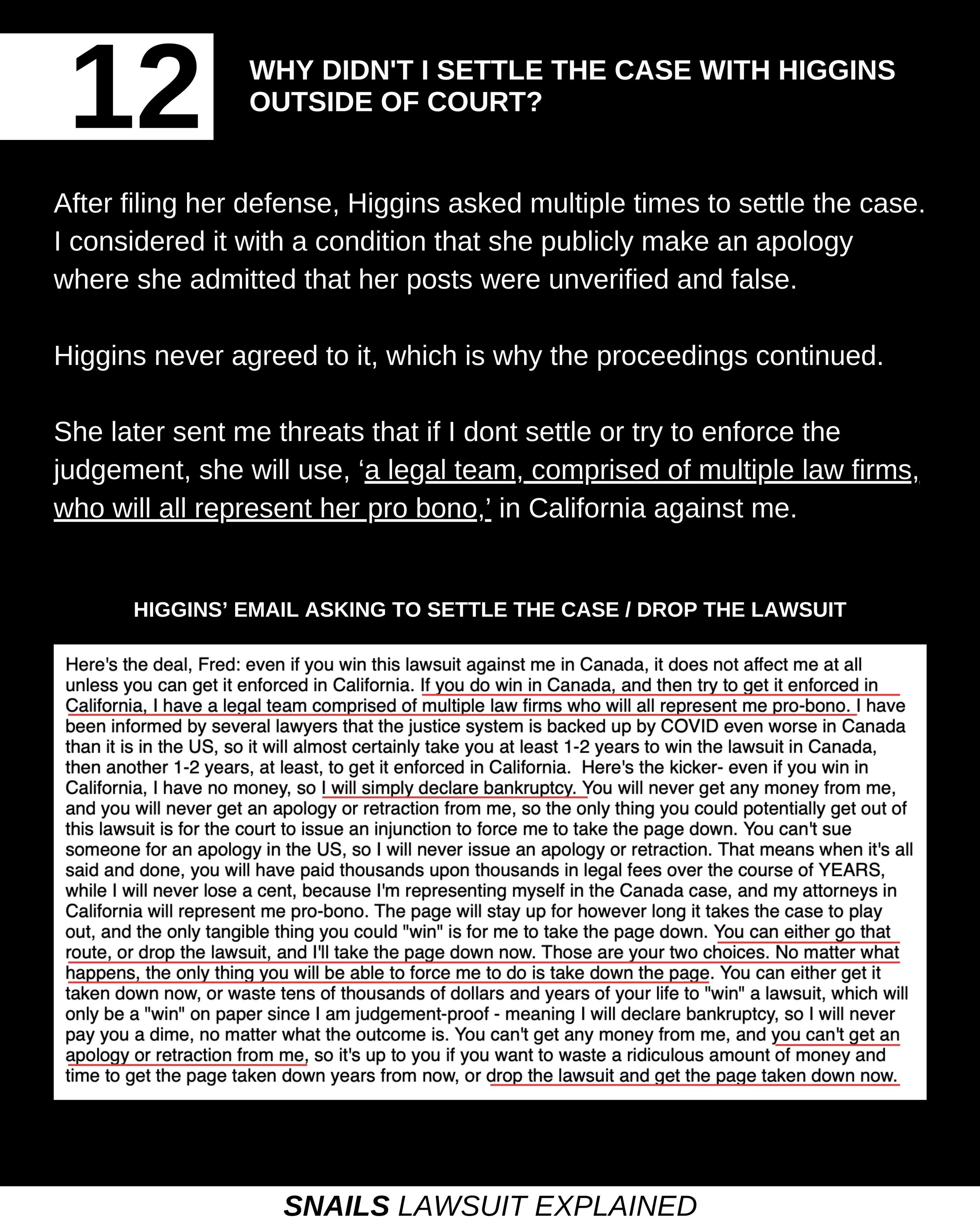
After filing her defense, Higgins asked multiple times to settle. I considered it with one condition: that she publicly admit her posts were unverified and false and issue an apology. She never agreed to it.
She later threatened that if I didn't settle, she would use a "legal team comprised of multiple law firms who will all represent her pro bono" in California. When the case proceeded, that legal team never appeared. She defended herself — and then stopped defending at all.
Didn't Higgins not fight back because the judgment doesn't affect her?
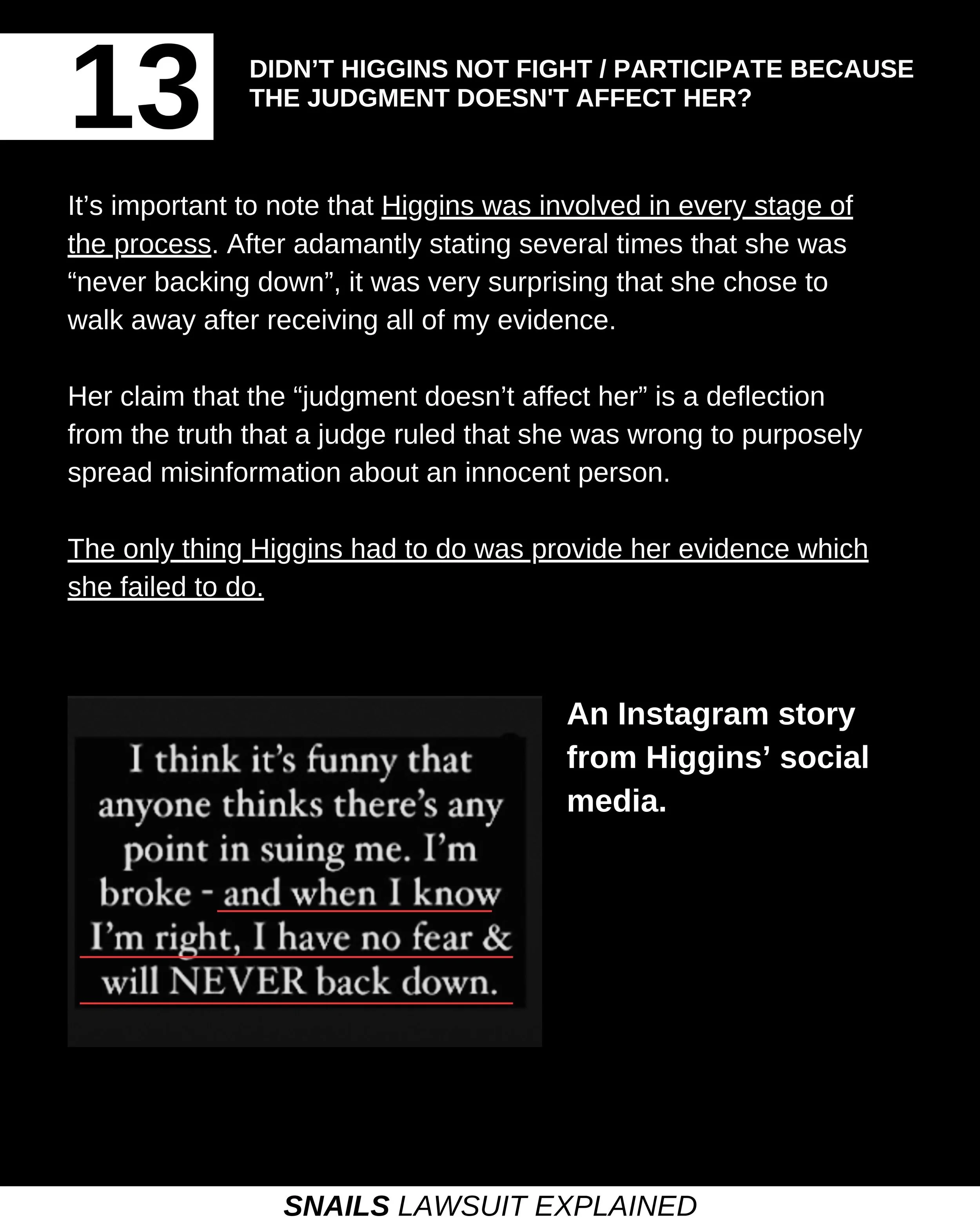
Higgins was involved in every stage of the process. After repeatedly stating she was "never backing down," she walked away entirely once she received all of my evidence. Her claim that the "judgment doesn't affect her" is a deflection from the truth that a judge found she was wrong to purposely spread misinformation about an innocent person.
Justice Devlin [para 168]
Ms. Higgins is permanently enjoined from publishing any statement, original or derived from other existing material or posts in the public domain or otherwise, suggesting that Mr. Durand has committed sexual assault, physical assault, or has behaved in a sexually inappropriate manner in the context of interacting with his musical fans, or otherwise.
Didn't Higgins claim the lawsuit was unfair because of anti-SLAPP and US free speech laws?
Higgins publicly stated she was protected by the First Amendment and California's anti-SLAPP law. Justice Devlin directly addressed this and rejected it.
Even applying the US standard — the New York Times "actual malice" test — Higgins still loses. The court found she acted with reckless disregard for the truth, which meets that very standard. Her malice defeats all defences under both Canadian and American law.
Justice Devlin [para 45]
In this case, Mr. Durand expressly alleges that the defamatory publications were malicious in a manner that would meet both the New York Times and the Grant standards for liability — namely that Ms. Higgins acted with reckless disregard for the truth of the allegations she published.
Justice Devlin [para 132]
Her malice defeats all the defences to libel under Canadian law, and indeed under American law as well.
How is the judgment valid when Higgins barely participated in the case?
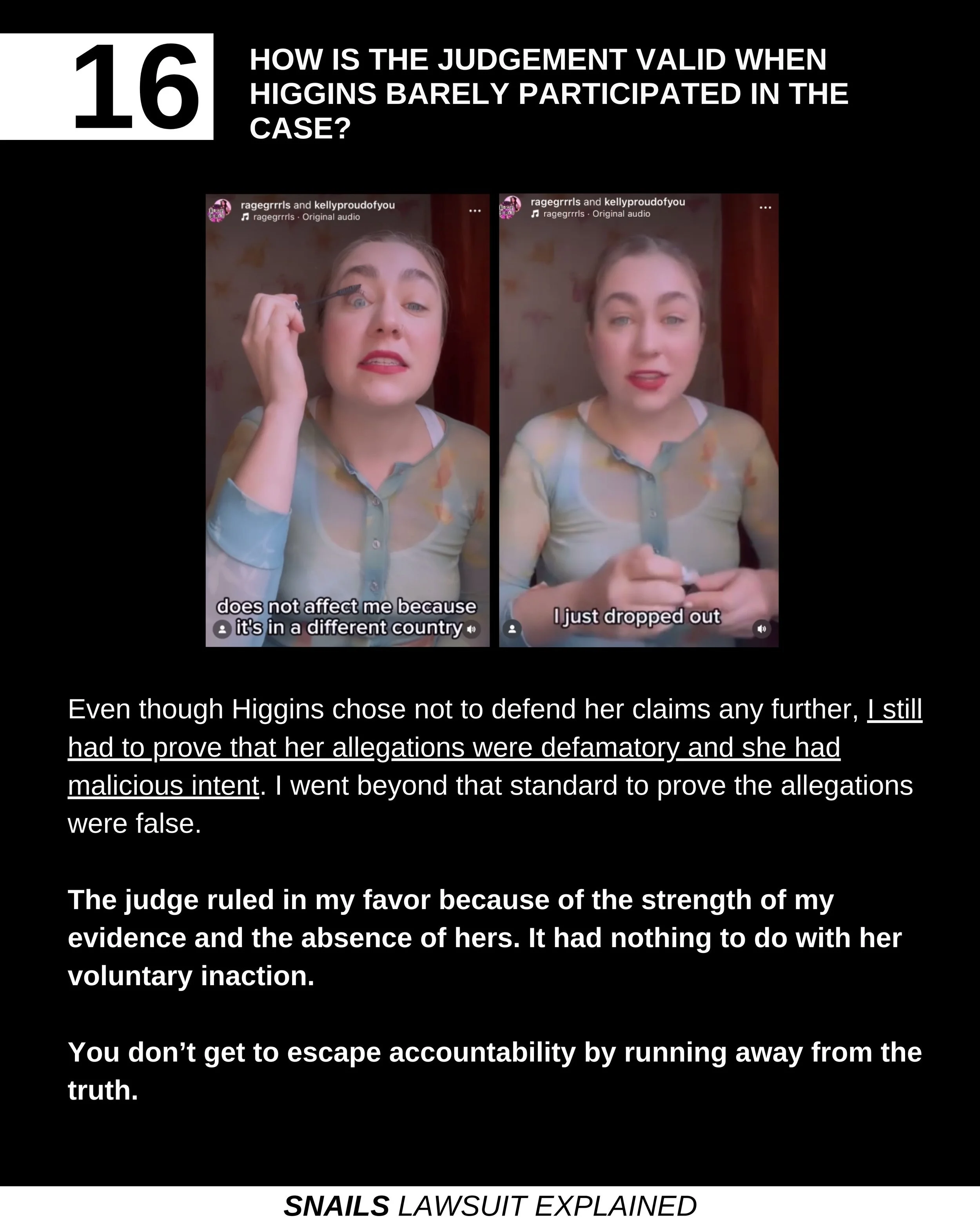
Even though Higgins chose not to defend her claims further, I still had to prove the publications were defamatory and establish malice. I submitted evidence addressing the individual allegations, and the judge ruled in my favor on the strength of that record, not on Higgins' absence alone.
Justice Devlin [para 54]
The suitability of this case for summary judgment turns largely on the fact that it has not been substantially defended. Ms. Higgins has made no attempt to prove the truth of the allegations she republished. No defences are pled, and the unanswered affidavit evidence offers Mr. Durand's full case.
You don't get to escape accountability by running away from the truth.
Does winning defamation only mean you proved the allegations were defamatory — not that they were false?
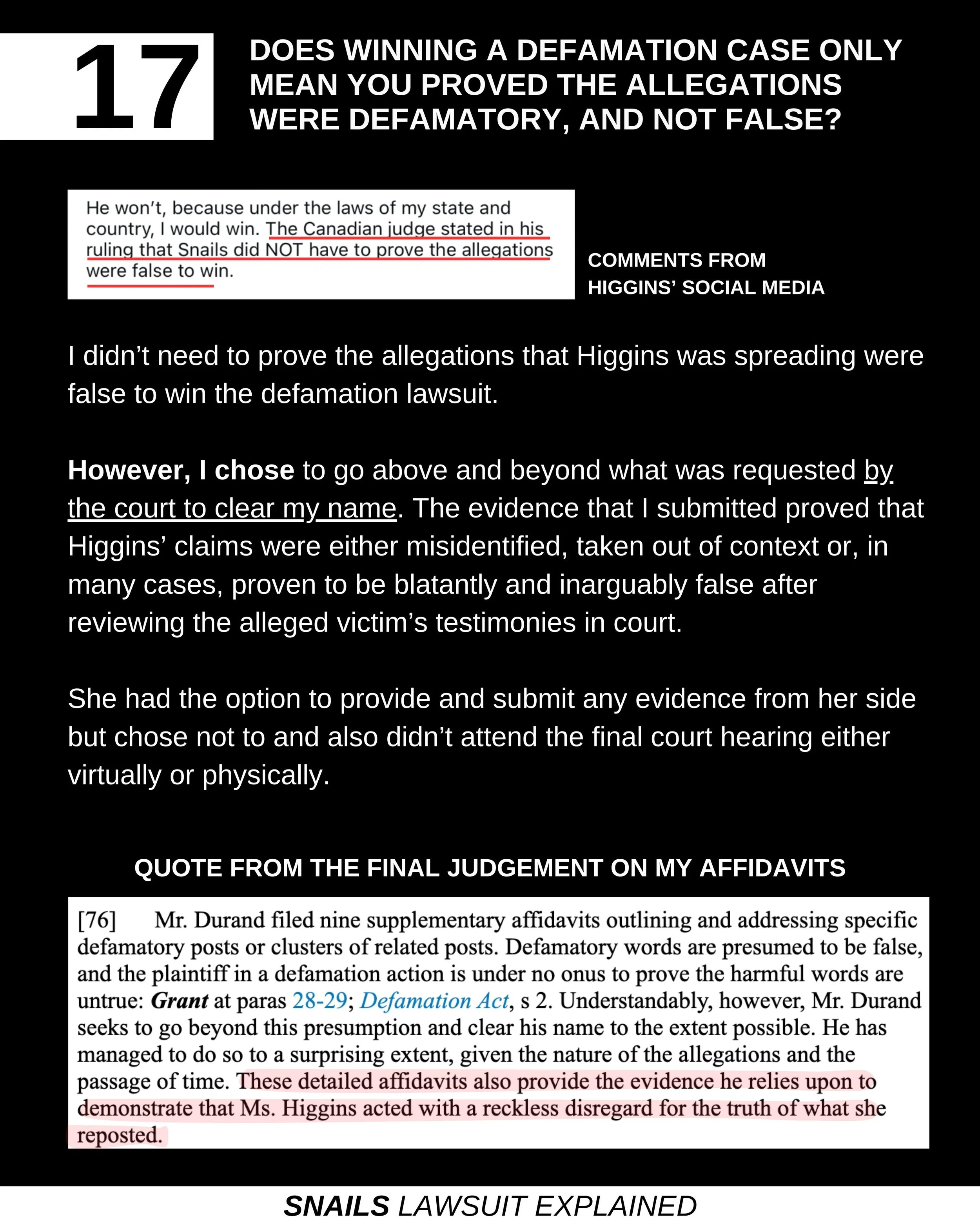
Under Canadian law, defamatory words are presumed false. I did not need to prove falseness to win. I nevertheless submitted evidence addressing individual allegations. The judgment identified a demonstrably false attack, found other claims contradicted by dated records, and stated that I had cleared my name to a surprising extent.
Justice Devlin [para 76]
Defamatory words are presumed to be false, and the plaintiff in a defamation action is under no onus to prove the harmful words are untrue. Understandably, however, Mr. Durand seeks to go beyond this presumption and clear his name to the extent possible. He has managed to do so to a surprising extent, given the nature of the allegations and the passage of time.
Why didn't SNAILS address the allegations earlier?
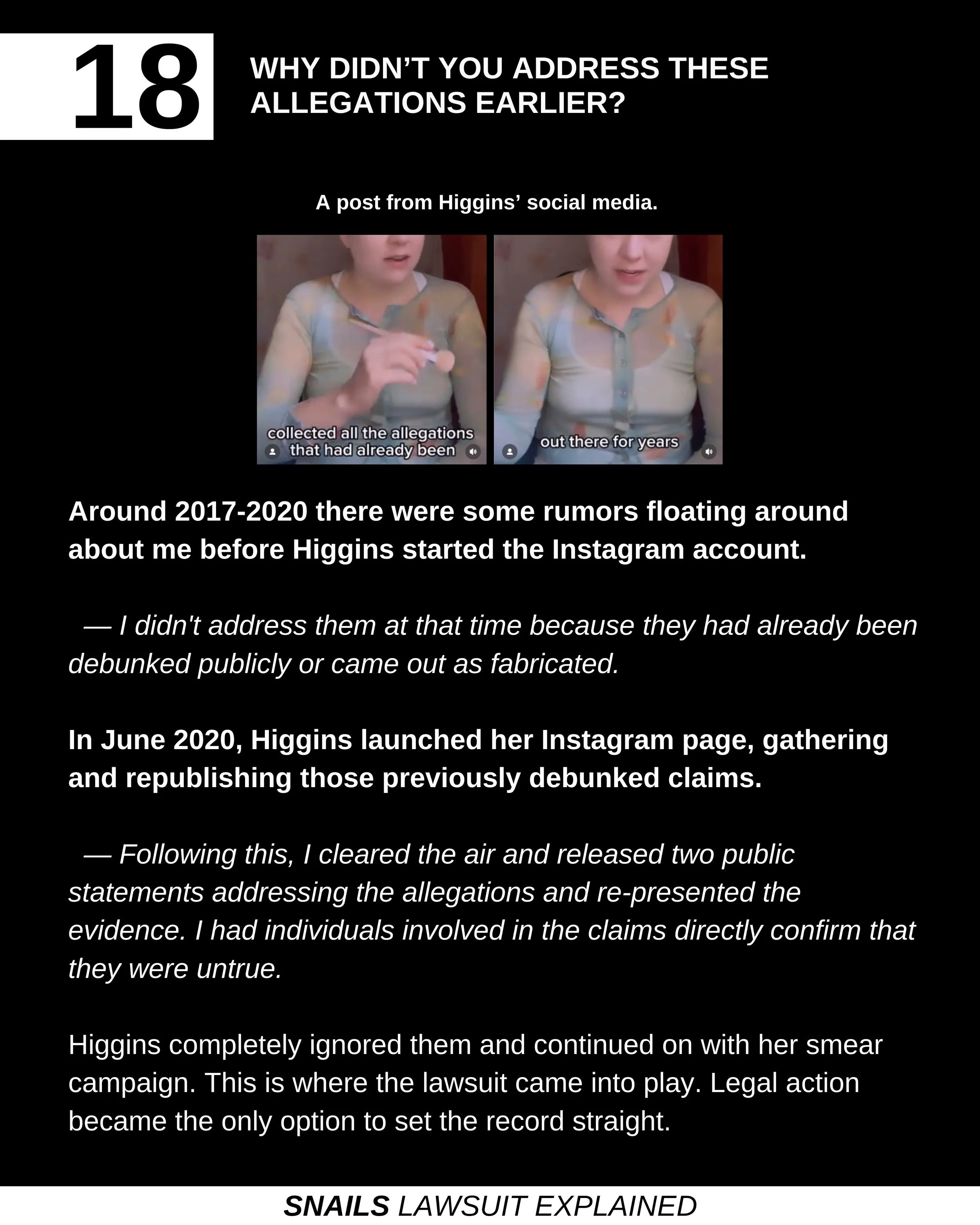
Around 2017–2020 some rumors circulated — and were publicly debunked or came out as fabricated. I didn't address them because they had already been addressed.
In June 2020, Higgins launched her Instagram page, gathering and republishing those previously debunked claims as a coordinated campaign. Following this, in January 2021 I released two public statements addressing the allegations, re-presented the evidence, and had individuals involved directly confirm the claims were untrue.
Justice Devlin [para 109]
In January 2021, Mr. Durand released public statements addressing the allegations against him. In these Public Statements, Mr. Durand denied any sexual misconduct and stated he stands by any victim of sexual assault, harassment, or abuse of any kind and that none of his actions fall into this category.
Higgins completely ignored the statements and continued her campaign. Legal action became the only option to set the record straight.
What about people who still believe the SNAILS allegations despite the court ruling?
Everyone is entitled to their own opinion, but opinions do not override the court record. The Alberta Court of King's Bench made explicit findings of falsity, including an intentionally, demonstrably false attack, and found many allegations, including the most serious, likely false or unreliable. I encourage readers to review Durand v Higgins, 2024 ABKB 108 on CanLII.
If anyone genuinely believes they have been wronged by my actions, I encourage you to come forward through proper legal channels. For any claim to hold weight, it needs to be based on evidence.
No accuser came forward to substantiate any anonymous, second-hand, or third-hand account allegation. The absence of a real accuser or direct testimony made it clear that these were unfounded claims. The court noted the frequent anonymity of the mostly second and third-hand statements that formed the basis of the Instagram Account's campaign.
Justice Devlin [para 118–119]
Given the anonymous and unsourced nature of these allegations, Mr. Durand is unable to provide concrete evidence to the contrary. Given Ms. Higgins' decision not to defend the truth or good faith of her publications, Mr. Durand benefits from the presumption that these allegations are false.
Why should people believe SNAILS when there were so many allegations?
The volume of Higgins' reposts is not evidence of truth — it is evidence of how widely she broadcast unverified, anonymous, second-hand content. Her reposts included allegations about other artists misidentified as being about me, personal opinions about my music, and claims that were publicly retracted by the original posters.
To address the allegations, I submitted 10 affidavits, which were sworn written statements supported by dated records. The judgment states that this evidence cleared my name to a surprising extent and records specific findings of falsity.
Justice Devlin [para 128]
In this case, there is no evidence that Ms. Higgins attempted to verify any of the claims prior to reposting them. She repeatedly ignored inconsistent or contradictory material that was available to her online at the time of her reposting. The overall package of her behaviour is the antithesis of responsible journalism.
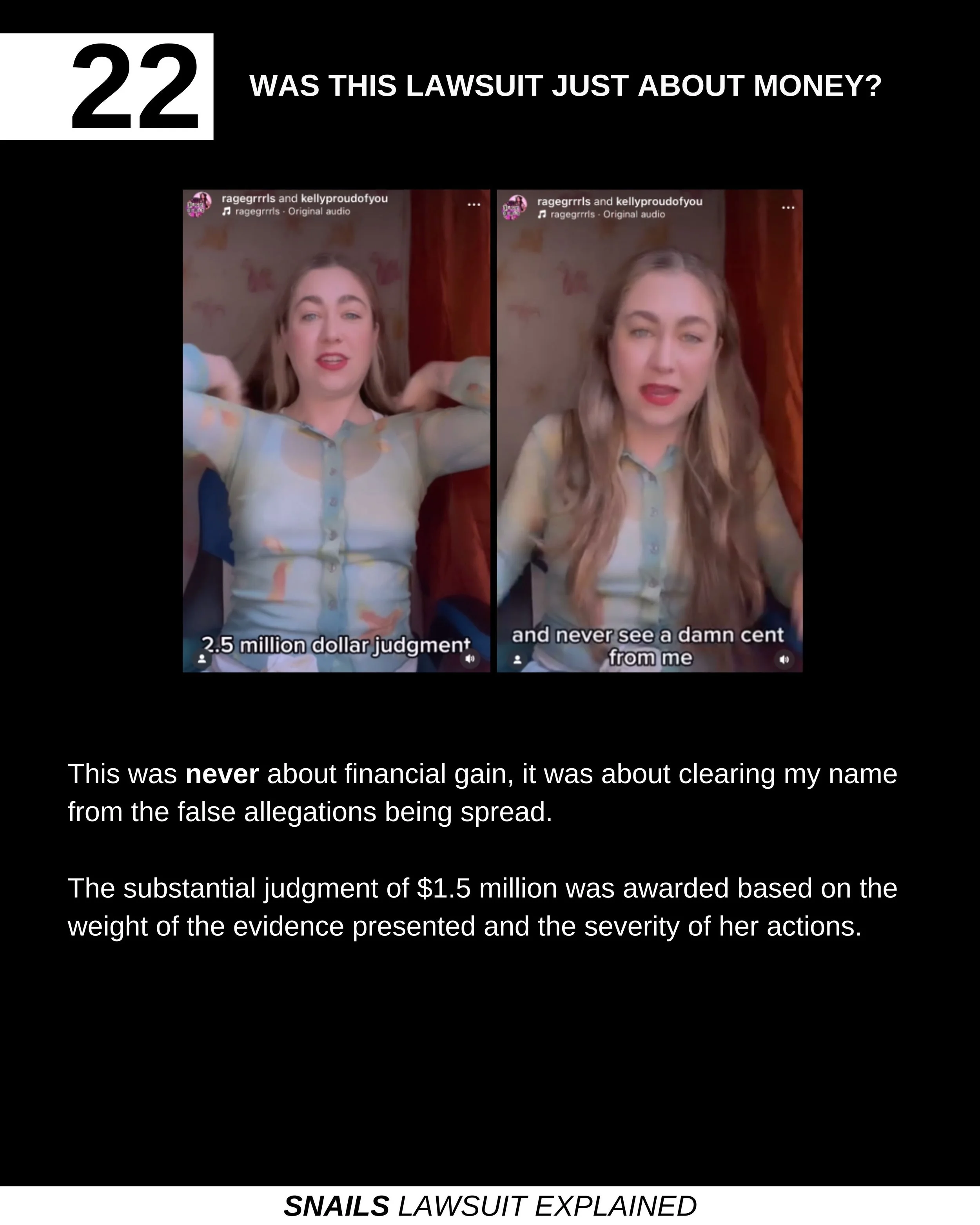
This was never about financial gain. It was about clearing my name and stopping the spread of false allegations. The $1.5 million judgment reflects the documented, quantified damage done to my career by Higgins' campaign — not an arbitrary number.
Justice Devlin [para 147–148]
I am satisfied beyond a balance of probabilities that the Instagram Account achieved its stated aims and was a dominant cause of Mr. Durand's career decimation. In 2018, his businesses posted net pretax income of $852,339. In 2021 and 2022, the businesses lost $59,042 and $137,658 respectively.
A permanent injunction was also part of the relief sought — and granted. The goal was always to stop the campaign, not to profit from it.
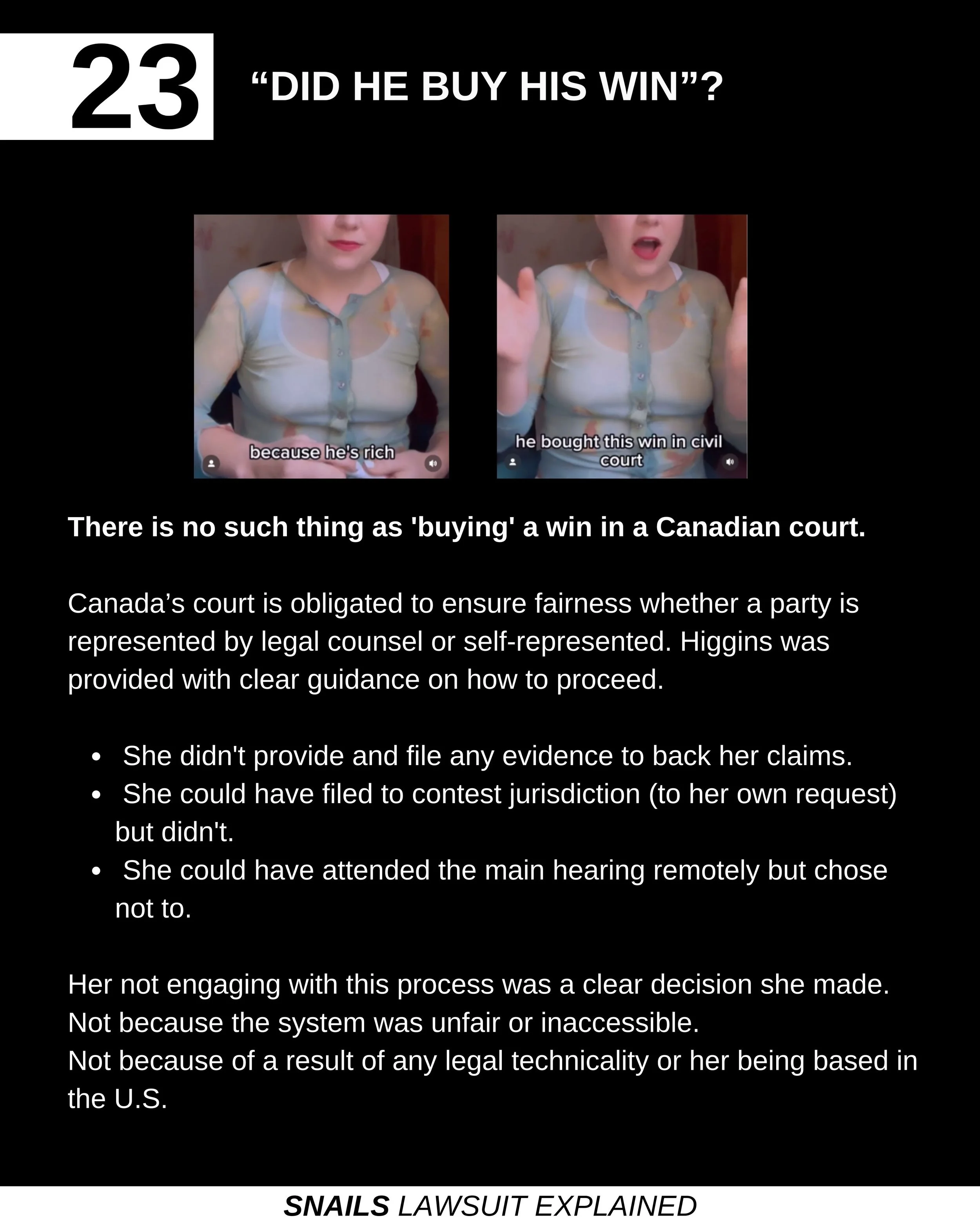
There is no such thing as buying a win in a Canadian court. The Court of King's Bench of Alberta applied a rigorous legal standard. Justice Devlin reviewed 10 affidavits, examined specific allegations against documented evidence, applied the full framework of defamation law, and wrote a 29-page reasoned judgment.
Higgins had the same access to the process. She filed a Statement of Defence, appeared at a pre-hearing, received all my evidence, and was offered virtual attendance at the final hearing. She chose to disengage at every stage after seeing the evidence.
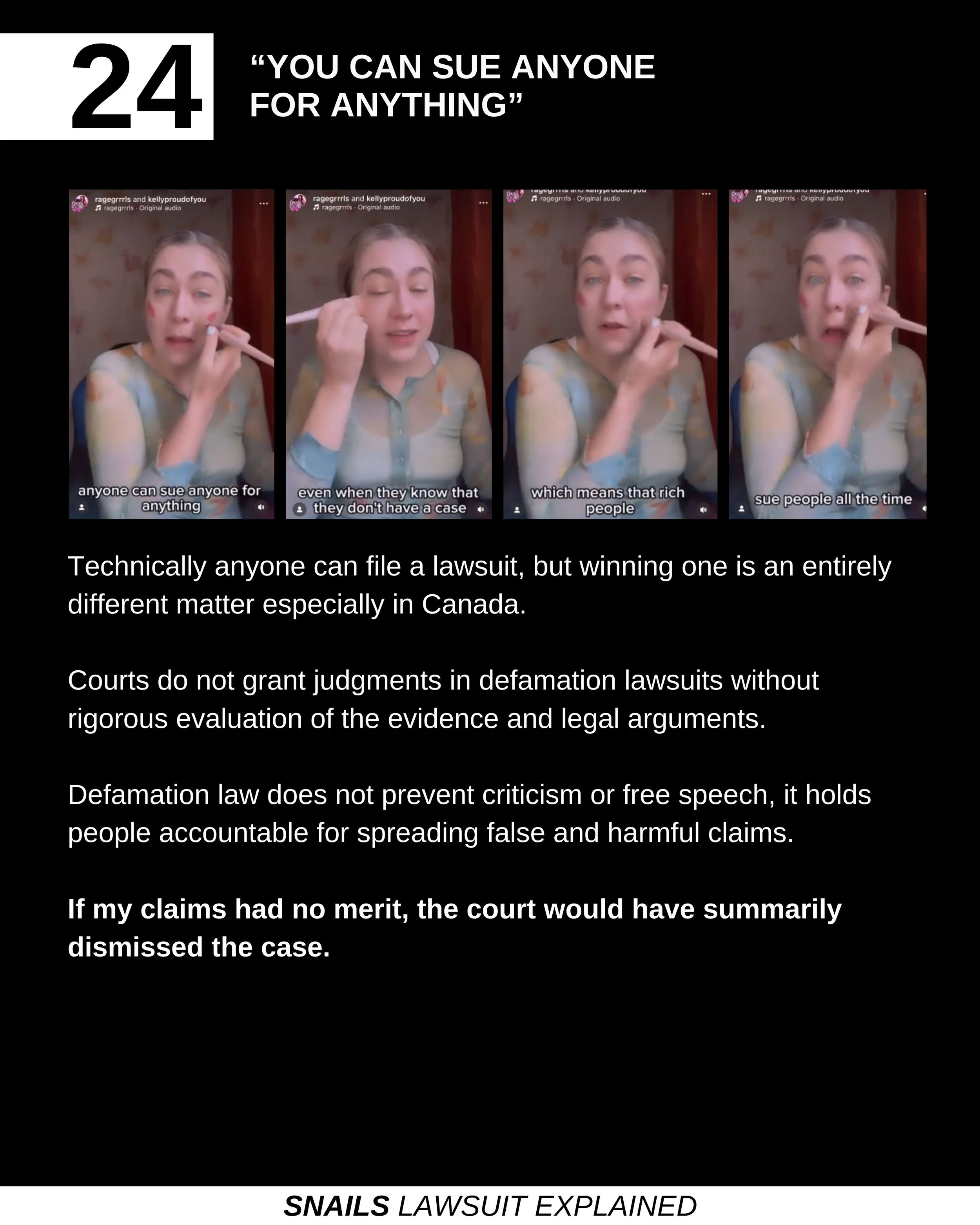
"You can sue anyone for anything" — does that apply here?
Anyone can file a lawsuit — but winning requires proof. The court applied the full test for summary judgment under the Weir-Jones framework, requiring a thorough review of the record and confidence that the result is fair and just. Courts do not grant $1.5 million defamation judgments on paperwork alone.
If my claims had no merit, Justice Devlin would have dismissed the case entirely. He didn’t.
As per the court: Higgins acted with malice — what does that mean legally?
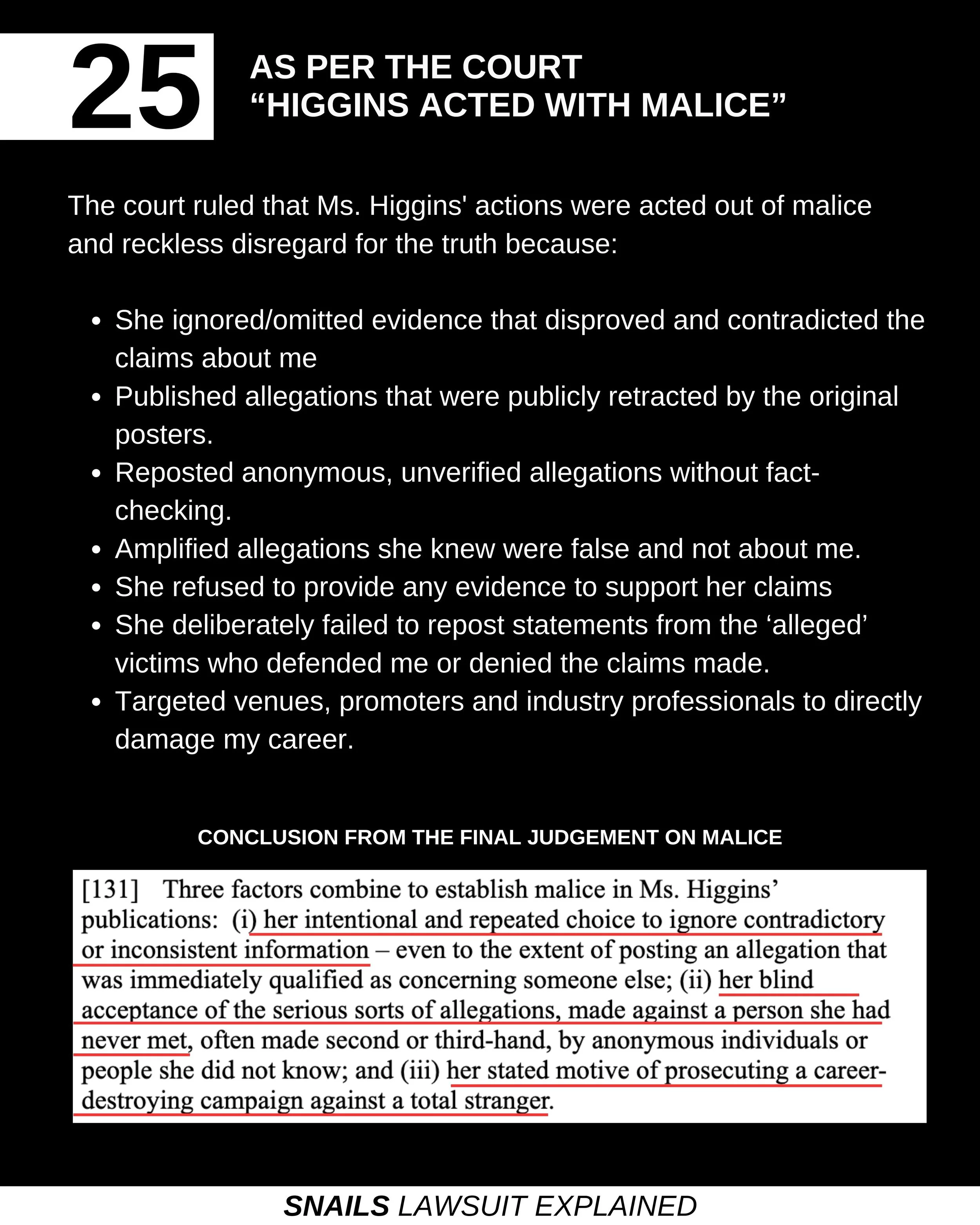
Malice in defamation law means the publisher acted with reckless indifference to the truth, spite or ill-will, or an ulterior purpose to harm — going beyond honest but careless belief. Justice Devlin found all three present.
Justice Devlin [para 131] — The Three Factors of Malice
Three factors combine to establish malice in Ms. Higgins' publications: (i) her intentional and repeated choice to ignore contradictory or inconsistent information — even to the extent of posting an allegation that was immediately qualified as concerning someone else; (ii) her blind acceptance of the serious sorts of allegations, made against a person she had never met, often made second or third-hand, by anonymous individuals or people she did not know; and (iii) her stated motive of prosecuting a career-destroying campaign against a total stranger.
Justice Devlin [para 132]
I find as a fact that Ms. Higgins was reckless as to the truth of the allegations she published, and indeed actively published allegations she knew or ought to have known were not about Mr. Durand, due to her personal animus towards him. Her belief in the truth of the libels she reposted was intentionally blind, because she had already decided harm should be done to Mr. Durand. Her malice defeats all the defences to libel under Canadian law, and indeed under American law as well.
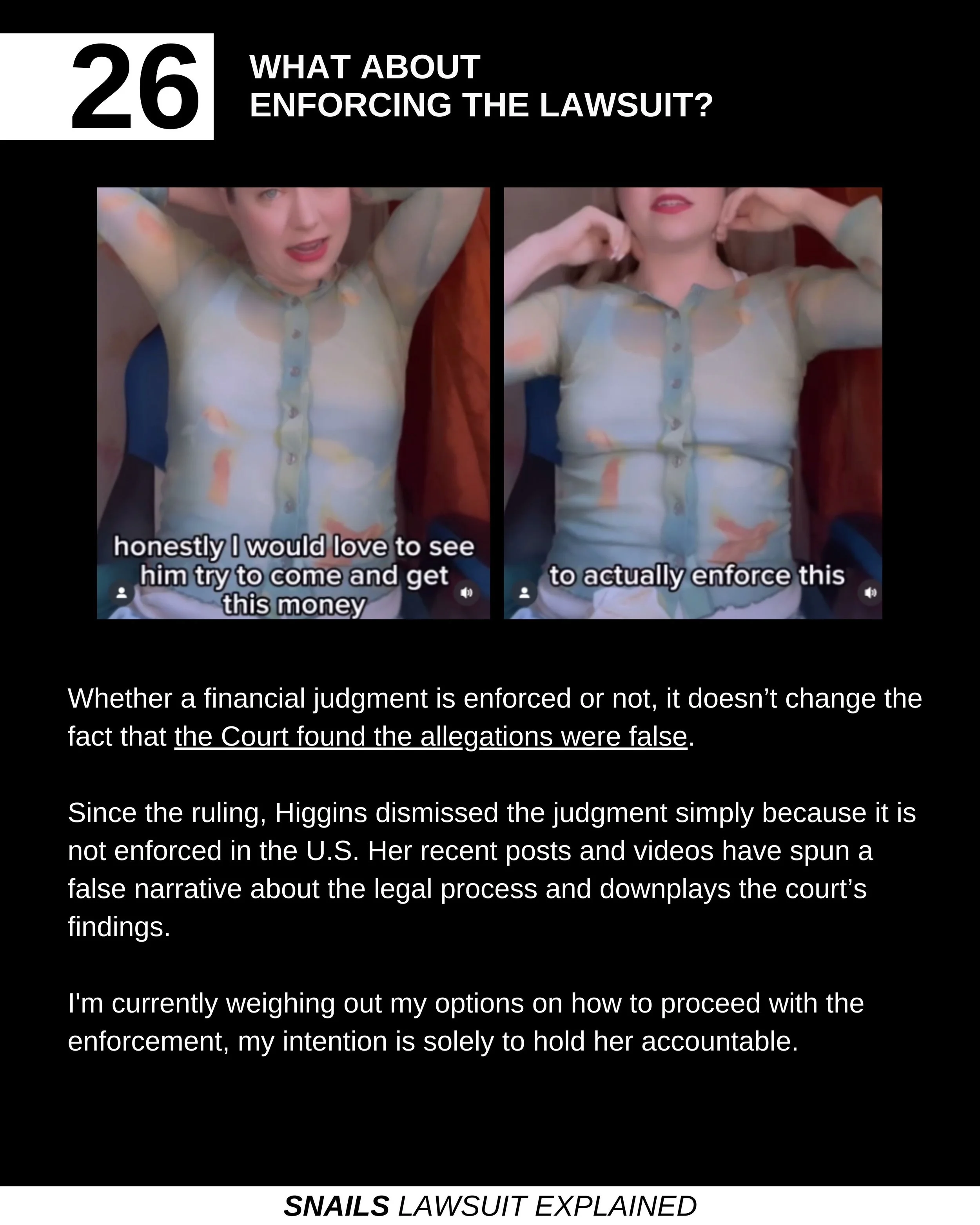
Enforcement does not change the judgment. The court made explicit findings that specific allegations were false, found many allegations, including the most serious, likely false or unreliable, and permanently enjoined Higgins from publishing sexual-misconduct allegations about Durand. Those findings remain part of the public record.
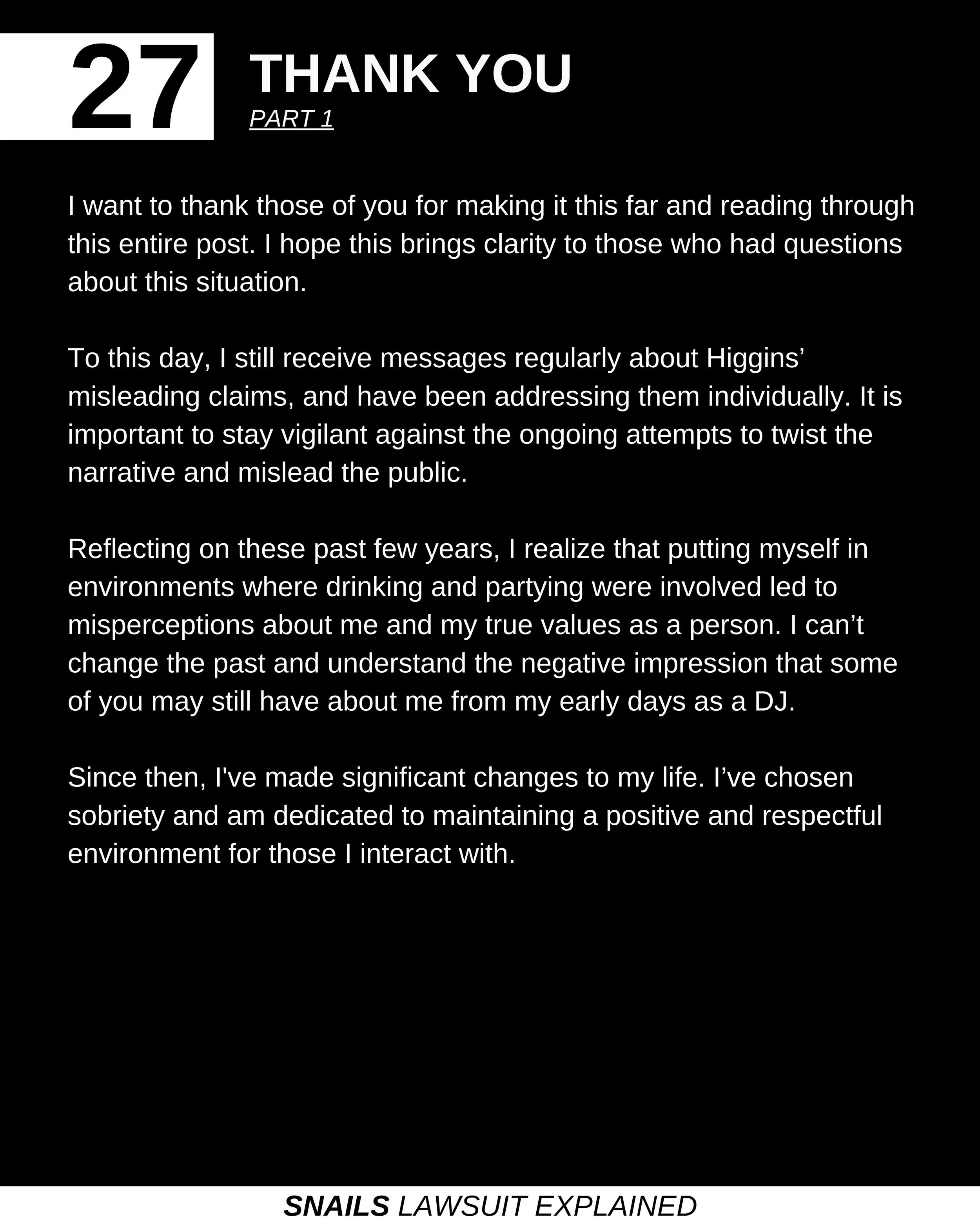
I want to thank those of you who made it this far. I hope this brings clarity to those who had questions about the SNAILS allegations.
To this day, I still receive messages about Higgins' misleading claims. It is important to stay vigilant against ongoing attempts to twist the narrative and mislead the public. The official judgment — Durand v Higgins, 2024 ABKB 108 — is publicly available on CanLII for anyone who wants to read it in full.
Reflecting on these past few years, I realize that putting myself in environments where drinking and partying were involved led to misperceptions about me and my true values as a person. I can't change the past and understand the negative impression some may still have from my early days as a DJ. Since then, I've made significant changes to my life. I've chosen sobriety and am dedicated to maintaining a positive and respectful environment for those I interact with.
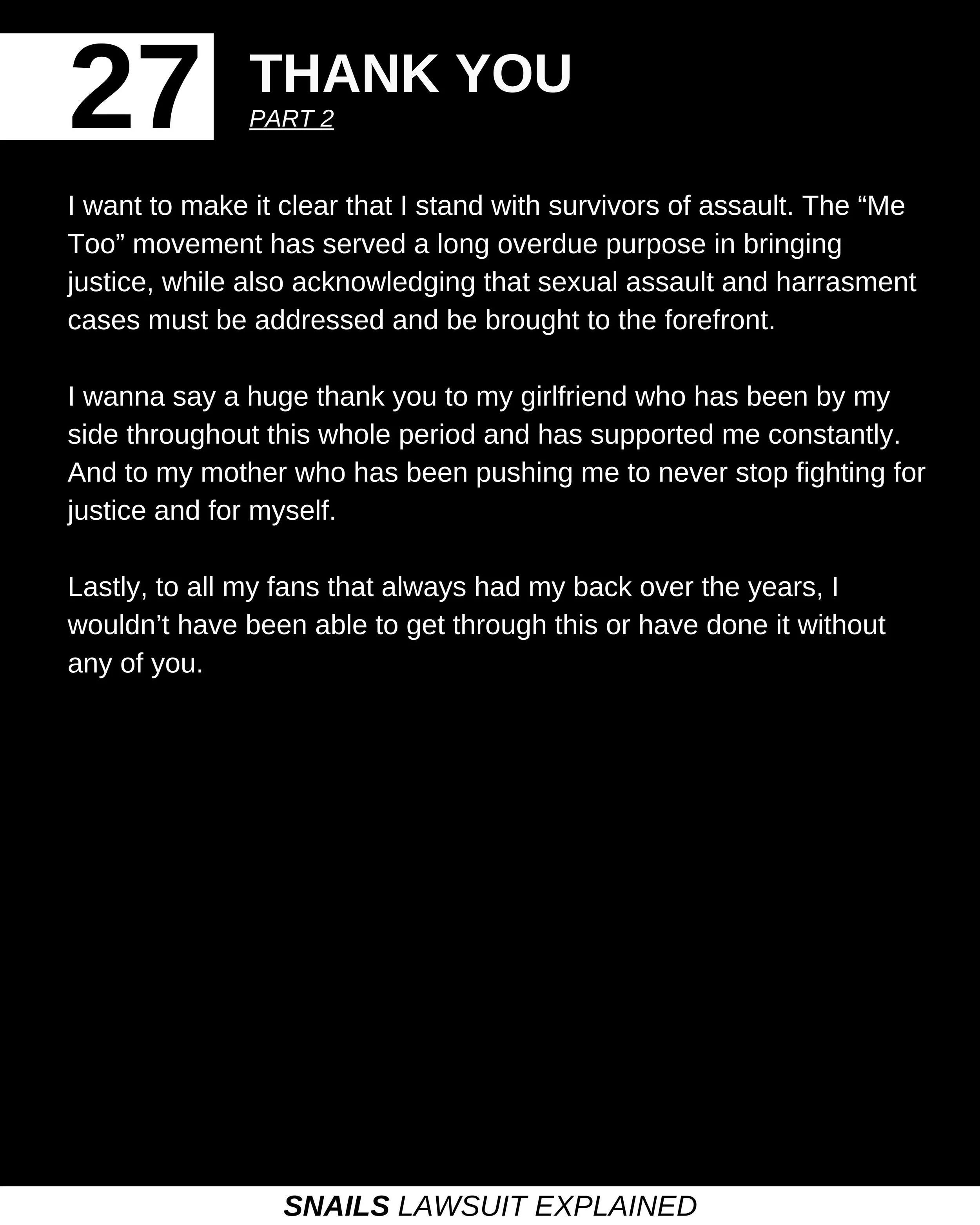
I want to make it clear that I stand with survivors of assault. The MeToo movement has served a long overdue purpose in bringing justice. For any accusation to serve justice, however, it must be grounded in truth and fairness to both the accuser and the accused — as Justice Devlin himself stated in his concluding observations.
False, careless, and ill-motivated reports have the potential to do immense, unjust harm, as appears to have been the case with Mr. Durand. This terrain calls for careful objectivity, not unrestrained zealotry. Those who seek to publicize allegations for the public good must be careful to be fair and accurate towards the individuals who are the subject of those allegations.
A huge thank you to my girlfriend who has been by my side throughout this whole period, and to my mother who has been pushing me to never stop fighting for justice. And to all my fans who always had my back — I wouldn't have been able to get through this without any of you.
Evidence page 1 of 34Evidence page 2 of 34Evidence page 3 of 34Evidence page 4 of 34Evidence page 5 of 34Evidence page 6 of 34Evidence page 7 of 34Evidence page 8 of 34Evidence page 9 of 34Evidence page 10 of 34Evidence page 11 of 34Evidence page 12 of 34Evidence page 13 of 34Evidence page 14 of 34Evidence page 15 of 34Evidence page 16 of 34Evidence page 17 of 34Evidence page 18 of 34Evidence page 19 of 34Evidence page 20 of 34Evidence page 21 of 34Evidence page 22 of 34Evidence page 23 of 34Evidence page 24 of 34Evidence page 25 of 34Evidence page 26 of 34Evidence page 27 of 34Evidence page 28 of 34Evidence page 29 of 34Evidence page 30 of 34Evidence page 31 of 34Evidence page 32 of 34Evidence page 33 of 34Evidence page 34 of 34
Page 1 of 34
Court record
Frequently asked questions
Court-backed answers about the false SNAILS allegations and Durand v Higgins, 2024 ABKB 108.
Were the allegations against DJ SNAILS false?
Yes. The allegations against DJ SNAILS were false. The record includes direct corrections from women connected to the allegations, ten affidavits, dated messages, and explicit findings of falsity.
Women connected to the allegations publicly contradicted and corrected the accusations. Some confirmed that encounters were consensual. One clarified that a post being used against SNAILS concerned a different DJ and that she had never met SNAILS. Others offered to support him in court.
Other allegations were contradicted by messages sent at the time, including records describing consensual encounters and conversations that differed materially from what was later claimed online.
SNAILS submitted ten affidavits addressing the allegations. Justice Devlin identified one repost as an “intentionally, demonstrably false attack” and found that Higgins acted with malice and reckless disregard for the truth. This conclusion does not depend on simply believing SNAILS. Women connected to the claims corrected the public story, dated records contradicted other allegations, sworn evidence was submitted, and the written judgment recorded explicit findings of falsity. (paras. 76, 88 to 89, 131 to 133)
What did the court find about Michaela Higgins and @evidenceagainstnails?
The court found that Michaela Higgins operated @evidenceagainstnails and acted with malice and reckless disregard for the truth. Justice Devlin found that she repeatedly ignored contradictory material and actively published allegations she knew or ought to have known were not about Durand because of her personal animus toward him. (paras. 131 to 132)
No. The SNAILS judgment was not a default judgment. Higgins filed a defence, appeared at case management, received the complete evidentiary record, and had every opportunity to challenge it. She then filed nothing in response, submitted no counter-evidence, did not cross-examine the affidavits, and chose not to attend the final hearing despite receiving Webex links. Justice Devlin reviewed the record and granted summary judgment. He wrote that her wilful failure to participate did not undermine the record and that litigants make tactical choices at their own risk. (paras. 6, 57 to 58)
The SNAILS judgment was supported by between 700 and 800 pages of evidence across ten affidavits, dated messages, public corrections, and Higgins's own posts. Women connected to the allegations came forward to defend SNAILS and correct the public record. One publicly said the allegation was false, confirmed the encounter was consensual, and offered to support him in court. Another said the post Higgins used concerned a different DJ and that she had never met SNAILS. Higgins received the full evidence binder. In her Instagram Story, she laughed at the amount of evidence and called it “a waste of paper.” She then filed zero pages of counter-evidence and cross-examined none of the affidavits. Justice Devlin reviewed the record and granted summary judgment. (paras. 57, 76, 88 to 89)
The court awarded SNAILS $1.5 million because Higgins pursued a malicious campaign built on false and defamatory allegations against a total stranger. Justice Devlin found that Higgins acted with malice and reckless disregard for the truth, intentionally ignored contradictory evidence, and published allegations she knew or ought to have known were not about Durand. The court found that this campaign caused his career decimation. The award included $1 million CAD in special damages, $350,000 in general damages, and $150,000 in aggravated damages for conduct the court found high handed, spiteful, and malicious. The court also issued a permanent injunction. (paras. 131 to 132, 147 to 164)
Michaela Higgins, also known as Caeli La, ran @evidenceagainstnails. The judgment states that she had never met Durand and had no first-hand knowledge of the allegations she republished.
Why was Higgins liable for reposting false SNAILS allegations?
Higgins was liable for reposting false SNAILS allegations because the court applied the repetition rule. A person who repeats or reposts a defamatory statement can be liable to the same extent as the original publisher. Higgins organized and republished the allegations through @evidenceagainstnails and targeted SNAILS' promoters and venues. (paras. 70 to 71)
The full public judgment is Durand v Higgins, 2024 ABKB 108, decided by Justice N.E. Devlin of the Alberta Court of King's Bench on February 26, 2024. It is available directly from CanLII.